A Look Back: Pacific Overtures in Tokyo
Here is an expanded version of an essay written originally for the Sondheim Review (reproduced here) discussing the innovative Tokyo production of the Japan-themed musical in 2000. The essay played a small role in helping to bring the production to New York in both Japanese and English. It discusses the differing perspectives of the American writers and Japanese director regarding the musical’s themes. A British-helmed production played in Tokyo nearly a quarter-century later but did not have the same impact. This longer essay was featured in The Oxford Handbook of the Global Stage Musical (2023).
————————————————————
Varied perspectives
The idea of a Tokyo production of Pacific Overtures, the 1976 musical oddity about the American-driven opening of isolationist Japan in the 19th century, has a rather dizzying feel: a Japanese production of an American musical about the Japanese reaction to the arrival of Americans in Japan. This is not like bringing a Japanese Pearl Harbor Memories to Honolulu, but it is true that the momentous changes that Commodore Perry’s arrival helped foment, a quaint story for most foreigners, are a vital part of the Japanese national identity. Indeed, many of the events and characters portrayed in the show – Japan’s self-imposed isolation from the world, Manjiro, the Tokugawa shogunate, the Meiji revolution and its consequences – are as familiar to any Japanese schoolchild as George Washington and the Revolutionary War are to Americans.
Even so, as the show was written by Americans for American audiences, the different perspective made a Japanese production a challenge in some unexpected ways. Amon Miyamoto’s radical Japanese-language rethink at Tokyo’s New National Theatre nearly a quarter-century later in October 2000 shed new light on the show and proved an unquestioned critical and popular triumph for composer Stephen Sondheim and book writer John Weidman, who attended the final performances. Sondheim declared it ‘sensational’, while Weidman remarked: ‘I feel Miyamoto-san’s choices delivered the intention of the show more successfully than it has ever been delivered before. Indeed, it is hard to imagine a more sensitive interpretation of what Hal [original director Harold Prince], Steve and I intended.’ The success of the one-month run prompted a revival two years later at the same theatre and again in 2011 at the Kanagawa Arts Theatre in Yokohama, where Miyamoto was serving as artistic director. The original Japanese production travelled to Washington DC and New York’s Lincoln Center in 2002, and, in a nice reversal, was recreated by the director in English two years later on Broadway, where it received a Tony Award nomination for Best Musical Revival.
Yet how did the Japanese themselves view the show, and how did they react to both its text and the production? These important questions will be considered below.
The Show’s Gestation and Original Reception
Sondheim has spoken of seeing a three-panelled Japanese screen in New York’s Metropolitan Museum of Art as part of his research for the show. He recalls that he was overwhelmed by the near blankness of the middle and right panels, reflecting what he saw as Japanese minimalism, and cites this as a prime inspiration for his work on the musical.
It is worth noting that formal screens were often created as backdrops for dignitaries, designed with densely painted outsides and mostly blank middle sections so that the sitter would be highlighted and not obscure the work. If that is the case here, what Sondheim saw as an empty space would in fact be where a high-ranking person would sit. That is, the screen was not simply decoration but a functional object, and the space was not blank; it was simply missing the human as the final piece, like a lyric without the music.
That’s essentially how Westerners view Pacific Overtures. Without a knowledge of the circumstances behind Perry’s mission or the crumbling structure of Japan’s shogunate (military government), audiences see only a limited picture of the whole. Differing readings of musicals among cultures are hardly rare; My Fair Lady, for example, seen by the British as an archetypal study of class, is to US viewers a typical American success story where even a flower girl can become a princess if she works hard enough. Still, Japan’s starkly different history and relation to the West make for an especially enlightening comparison when considering the reception of the 1976 show.
Even within Sondheim’s extraordinary oeuvre, which encompasses shows about crushed illusions (Follies, 1971), cannibalism (Sweeney Todd, 1979) and presidential assassins (Assassins, 1990), Pacific Overtures stands out for the eclectic choice and treatment of its topic. The show was not originally conceived as a musical: Weidman, drawing on his studies in East Asian history at Harvard, had written a play about America’s incursion into Japan. It was the legendary director Harold Prince who suggested portraying the story from the Japanese perspective and, to Weidman’s surprise, envisioned it as a musical. He then convinced a reluctant Sondheim to go along. The major characters are all Japanese, with Westerners limited largely to brief song appearances. Sondheim describes the show as ‘historical narrative as written by a Japanese who’s seen a lot of American musicals’. Sondheim’s score strives to reflect this with a ‘less is more’ style in both music and lyrics to approximate a traditional Japanese sound and sensibility, attempting to ‘infuse the lyrics with the evocative simplicity of haiku’. Most strikingly, Prince employed a daring kabuki-inspired approach to highlight the ‘otherness’ of the East: it used an all-male cast, white painted faces and exaggerated acting styles, while the set emphasized what the director saw as the flatness of kabuki theatre, spreading the action across the length of the stage.
It was a highly inventive if commercially risky production of a type that is probably no longer possible under the current economic regime of Broadway. Failing to find public favour in the shadow of that year’s mega-hit A Chorus Line, the show closed after only 193 performances, the shortest run of the four Prince-Sondheim collaborations up to that time and the first not to win a Tony for Best Musical Score. Tellingly, John Simon wrote years later that for him a basic problem with the show was that ‘[t]he opening up of Japan is not a topic that elicits potent echoes in our psyche…’ That was obviously not a problem for the Tokyo production.
The show’s story derives from an historical incident, the uninvited arrival of US Admiral Matthew Perry off the shores of modern-day Tokyo in 1853. Perry was on an official mission to pry open an isolationist Japan to trade, whether Japan wanted this or not. Japan’s capitulation and signing of a formal trade treaty the next year opened the floodgates for other Western nations, followed in rapid order by civil war, the toppling of the government, a wholesale upheaval of society, and a headlong plunge into the modern era, all of which is touched upon in the span of this remarkable musical.
The story begins with the arrival of a number of massive American warships, ‘four black dragons’, on Japanese shores, sending the government into a frenzy. Kayama, a minor official initially tasked with getting rid of the frightening invaders, has enlisted the help of Manjiro, an English-speaking fisherman who, having lived for some time in America after his rescue at sea by US sailors, had been imprisoned back in Japan for dealing with foreigners. Though failing in his mission, Kayama becomes increasingly enamoured of the Western lifestyle after the rise of the new government, while Manjiro despairs at what is being lost. Their relationship and Japanese history move relentlessly in a direction neither envisioned.
Despite the Japanese setting, reviews through the years suggest that Americans look upon the show largely as a comment on themselves. In their minds, the point of the show, coming in the wake of America’s withdrawal from Vietnam, was the inadvertent consequences of intervention into the political affairs of other nations. The New York Times, discussing a later Chicago revival, saw the musical’s theme as ‘the West’s reckless insinuation of itself into the affairs of the other hemisphere’ and the dangers of ‘the superimposition of one culture on another, however well intended…’ In this context, the review noted a connection with the American involvement in Afghanistan, which was just getting under way.
Pacific Overtures in Tokyo
The Japanese production got its start when Miyamoto, who had made his name with his lively take on classic American musicals, was approached by Tokyo’s New National Theatre to direct a musical of his choice. Miyamoto had long been interested in Pacific Overtures after watching a broadcast on Japanese television in 1976 of the original Broadway production, which had been filmed by the Coca-Cola Company as a gift to Japan to commemorate America’s bicentennial. Seen largely as a curiosity, the show was never rebroadcast and was not considered commercially viable for a local staging given its unusual structure, especially the kabuki-inspired format. It quickly faded from memory. Miyamoto, an unabashed Sondheim fan, saw the New National Theatre’s offer as his perfect chance. With the theatre’s enthusiastic backing, he took a new look at the forgotten musical and spent the next year and a half developing it, including much back-and-forth with the creators over proposed changes.
Sondheim was not unknown in Japan, but occasional productions of his shows, from Company and Sweeney Todd to such unlikely candidates as Do I Hear a Waltz?, had made little impact. His fame derived almost entirely from his work as lyricist for West Side Story, a seminal show that helped spark Japan’s enduring musical boom upon its first Japanese-language performance in the 1960s. He was honoured in 2000 with Japan’s prestigious Praemium Imperiale, often described as the ‘Nobel Prize of the Arts’, but that was connected largely with West Side Story and his fame in the West; the obscure Pacific Overtures was not even mentioned, though a small photo of the show does appear inconspicuously on the website. In an uncanny coincidence, the award ceremony was held toward the end of Pacific Overtures’ brief Tokyo run. Taking advantage of the fortuitous timing, Sondheim brought Weidman along to Japan to catch the show.
Notwithstanding the mid-1970s television broadcast, the Japanese-language production represented the first experience with the show for the vast majority of the Tokyo audience. As opposed to the America-centric view of Broadway audiences, Japanese theatregoers tended to see the musical as a comment on the peculiarities of their own society, with Perry’s sudden appearance serving largely as a catalyst for changes that they considered inevitable over the long run. Their Japan was not a victim but very much the protagonist. Of course, they were seeing the incident within a much broader context.
For nearly 250 years, the shoguns, Japan’s military dictators, had artificially prevented change due to a perceived threat from foreigners by simply shutting off the island nation from the rest of the world. The rising interest that the public had shown in the West beginning with the arrival of the Portuguese in the 16th century was decisively suppressed: Japanese were expressly forbidden from leaving the country or having contact with foreigners, outsiders were not allowed into the nation, and foreign trade was restricted to limited exchange with the Dutch and Chinese on a small man-made island off the distant southern city of Nagasaki. The general peace associated with the period was imposed by considerable force from the centre. By the 19th century, the regime was coming under threat from mounting internal dissent, mainly from the southwest of the country, and the arrival of Perry’s ‘Black Ship’ was in some ways the excuse that the rebels had been waiting for. The subsequent opening of the country was only as dramatic as it was because the leaders had kept the lid on for so long; any contact with the rest of the world was bound to be a shock, as Japan could no longer open itself up in any organic way.
This is the perspective from which Japanese audiences approach the musical. The focus for them is not the rights and wrongs of the American incursion as such. They would not subscribe to the belief that the Americans were attempting to superimpose their culture on Japan; it was the abiding curiosity among the Japanese for things foreign that the shogunate had been so determined to repress in the first place. In their minds, America is neither to be blamed nor credited for developments that are rooted deep in Japan’s history and psyche. For instance, the government’s strong aversion to change of any kind unless compelled by outside pressure, so deftly portrayed in the musical, is a characteristic that remains much commented upon today.
One of the charges commonly levelled against the musical in the US is that the characters often seem little more than symbolic representations of ideas rather than flesh-and-blood figures. This was much ameliorated in Tokyo by the fact that such roles as the fisherman Manjiro (known in Japan as “John Manjiro”) and Emperor Meiji are well-known historical figures and thus immediately recognizable to Japanese audiences. While this does not preclude the need to develop the characters within the context of the show itself, the roles do come with built-in personalities that make any such weaknesses less apparent, similar to Hamilton’s reliance on Westerners’ familiarity with individuals like Thomas Jefferson and King George III. In this sense, Weidman’s book perhaps comes off even better in Japanese than in the original English.
The Physical Staging
Miyamoto sought in his production to highlight the distinction between the Japanese (‘us’) and the rest of the world (‘them’). His approach was already suggested in the poster art: as opposed to the American logo featuring a vigorous kabuki-esque figure, the Tokyo advertising reproduced a realistic (and none-too-flattering) rendering of Commodore Perry by a 19th-century Japanese artist.
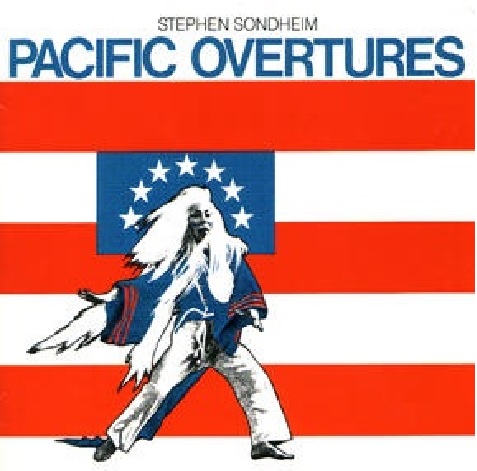
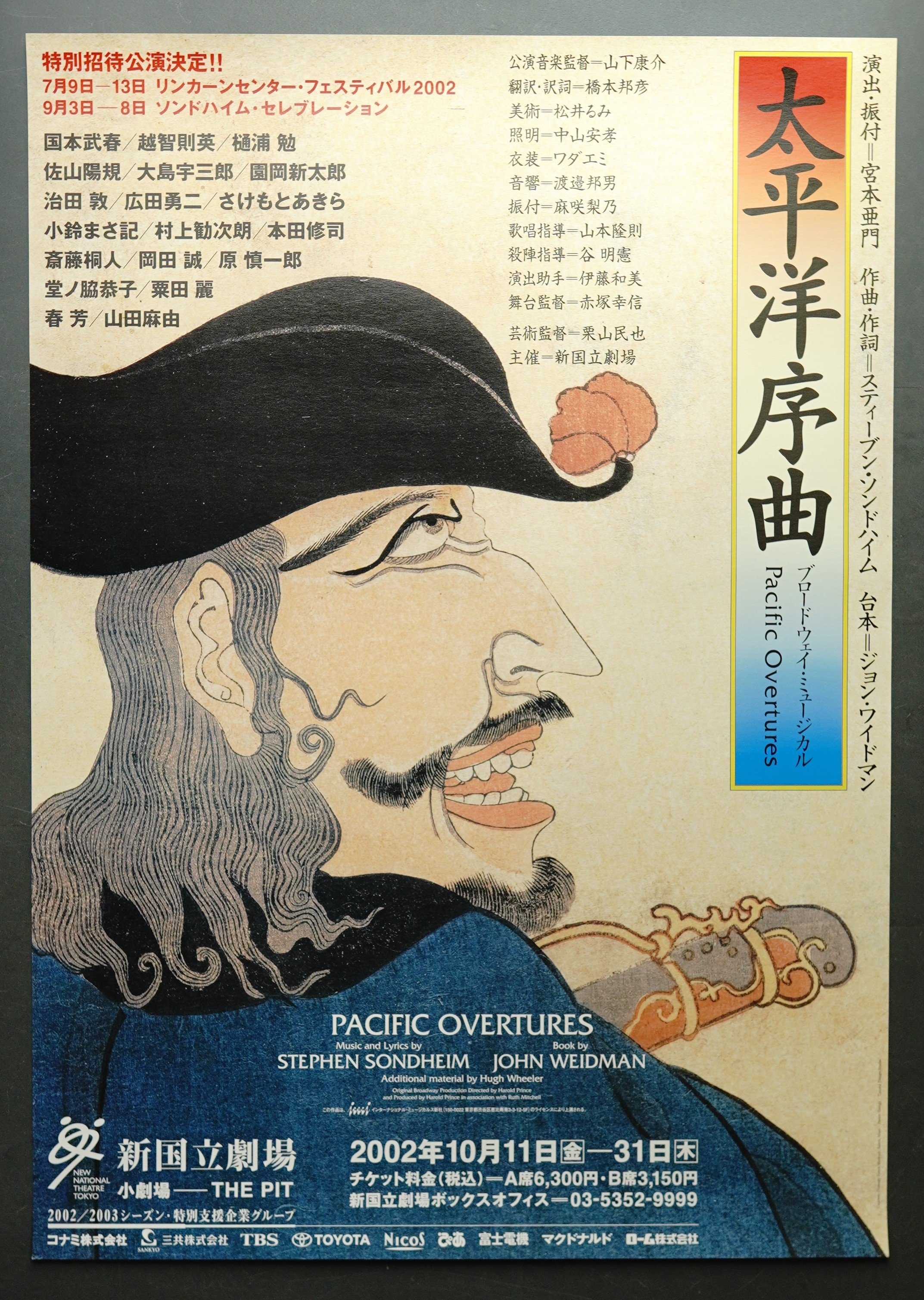
Original Broadway production (1976) Tokyo production (2000)
A visible metaphor for this division was established in the very structure of the set. The stage was a square platform surrounded on three sides by water, looking very much like the island “floating in the middle of the sea” described in the opening number. The stage was framed by two giant torii, the large crossbar-like structures that mark the entrance to shrines, thus suggesting the sacred nature of Japan. In the back was a wooden lattice frame with doors in the centre that opened to reveal two more sliding doors, which were used for scenes such as those with the emperor. This gave a feeling of multiple layers, of another world within. Screens were also introduced, in extremely inventive ways, for many other scenes. During the first act, before the nation was ‘violated’, Japanese characters all remained within the confines of the stage proper, an effective symbol for the nation’s isolation.
In contrast, the hanamichi, the walkway extending to the back of the theatre, represented the sea and more generally the world outside. The Black Ship never appeared as it did so memorably in Boris Aronson’s Tony-winning design, remaining an abstract presence, and foreigners initially stayed exclusively on the hanamichi. Thus, the hanamichi was used not just for entrances and exits as in Prince’s concept but for entire scenes involving the foreigners, who delivered their lines essentially from the middle of the audience. This gave an other-worldly quality to the foreign invaders and added a three-dimensional aspect to the show, pulling the audience into the action. In the real payoff, it heightened the drama significantly in moments when the gap was breached, such as Kayama’s venture onto the hanamichi to confront the Black Ship as well as the eventual entrance of foreigners onto Japanese soil. The invasion of the foreign ambassadors in ‘Please Hello’ put an end to the divide, with foreigners and Japanese alike appearing subsequently on both sides of the footlights.
More strikingly, the director abandoned the distinctive kabuki style of the original production for a more naturalistic approach. He reasoned for one thing that Japanese audiences do not see Japan as particularly exotic – even the 19th-century setting is standard fare for television samurai dramas. Moreover, as kabuki is a well-entrenched art form here, expectant audiences might hold acting and production standards to levels that ordinary musical actors could not hope to meet (Miyamoto himself was raised next door to one of Tokyo’s major kabuki theatres). In any event, a kabuki version would have required an entirely different style of acting and language that would have been more alienating than enlightening.
Thus, the Japanese scenes were generally acted, spoken and costumed in a fairly standard manner, as a kind of costume drama. The Reciter was portrayed in rokyoku style, a form of traditional storytelling. The role was played in fact by a well-known rokyoku comedian, Takeharu Kunimoto, who was able to interpolate some of the tricks of his trade, using a specific singing style and the three-stringed shamisen, in a way that made the role completely his own. Overall, the Reciter played a more dynamic and physical role than the stationary narrator in Prince’s version, adopting an ironic stance rather the angrier approach of the original. The rest of the cast played their roles as was appropriate.
In the impressive opening scene, the cast, all dressed in nondescript black outfits, appeared slowly on stage as a loin-clothed figure beat a taiko drum. As the Reciter took over, they gradually rose and disappeared, before reappearing in their costumes behind moving screens. The director thus established immediately the abstract feel of the overall piece as the Reciter told the story, even as the individual scenes themselves were presented realistically. In another example, ‘There Is No Other Way’ was not danced as in the original but intricately staged to the music as Kayama and his wife slowly prepared for his journey in a natural yet highly evocative manner. In ‘Four Black Dragons’, the actors again played their roles straight but were backed by an innovative use of wooden screens, which almost became characters on their own: unseen actors not only slid them across the stage but brought them forward, turned them on their sides, and wove them in to accent the music and action on stage. The director’s own favourite point of the show was ‘Someone in a Tree’, with its simultaneous representation on stage of past and present. He interpolated this idea into other moments, such as introducing Tamate as a ghostly vision in the early stanzas of ‘A Bowler Hat’.
The general presentation was straightforward; the sets were clean and spare, and even the exquisite costumes were generally in a subdued tone, mainly white (lords and high officials), blue (townspeople) and black (foreigners). The austere look of the show, inspired more by aristocratic noh theatre than populist kabuki, actually brought out the humour in an effective manner. Director Miyamoto is an old hand at comedy and made the most of his opportunities here.
Having ditched the kabuki style, Miyamoto also abandoned the concept of an all-male cast, employing women for the more serious female roles such as Kayama’s wife Tamate. This changed the dynamics of such scenes as ‘Welcome to Kanagawa’, which in Tokyo used only two men in drag along with three women. Local audiences were also deprived of the sudden jolt in the original production when women suddenly appeared on stage in the final number, ‘Next’. Worse, many women in the audience expressed offence at what they felt were stereotypically weak female characterizations, especially Tamate’s Butterfly-like suicide and the ‘Pretty Lady’ sequence. The use of men in these roles, as in kabuki, would have injected a layer of fantasy that might have made such scenes easier to accept. Still, this also involves questions of modern women’s image of themselves, which is a matter for another article. (It should be remembered here that the director, while Japanese, is also male.)
Miyamoto had his real fun with the foreign characters in the show. As opposed to the authentic costumes and look of the Japanese characters, the foreigners wore frightening half-face masks with huge noses and wild wigs, resembling the contemporary drawing used for the poster art. As that drawing suggests, foreigners must have been perceived as monsters, and the production shows this very humorously. Miyamoto gave Commodore Perry this same look rather than attempting to recreate the lion-like kabuki figure of the original script, making him into an awesome seven-foot figure. The director further preserved the Japanese/foreign divide by having the American characters on the Black Ship speak English as per the original script, a foreign language for the audience as well as the characters. Manjiro interprets back into Japanese for Kayama – and, therefore, the audience – which actually makes more sense than the original version. Miyamoto gets terrific mileage out of this at the end of the scene: when the Americans threaten in English to ‘blast [Japan] off face of earth’, Manjiro is speechless for a moment, leaving the expectant Kayama and the audience hanging before interpreting the news. This adds a wonderful comic touch that would be difficult to convey in an English-language production.
With the lion gone, Miyamoto cut the Lion Dance at the end of the first act, a major change that jettisoned much of the music and reworked the scene (with the authors’ permission, it should be noted) so that the foreigners were back on the hanamichi and the entire Japanese cast gathered on the stage. The invaders then scream, somewhat histrionically, ‘Remember America!’, followed by an immediate blackout, bringing the first act to a dramatic close.
The subsequent arrival of foreigners in ‘Please Hello’, when the various admirals bounded from the hanamichi into ‘Japan’, was performed appropriately broadly and very humorously. The various foreigners all had the same frightening masks as the Americans, with only different-coloured wigs to distinguish them. They had Lord Abe sign not documents but large national flags that they carried in with them, an interesting variation that again shows the stylized nature of the foreign scenes versus the more realistic Japanese scenes.
By contrast with the lovely and historically accurate Japanese costumes, there was a curious choice in terms of the foreign costumes. Rather than using the various uniforms of the nations represented, costume designer Emi Wada (an Academy Award winner for Akira Kurosawa’s Ran, 1985) dressed all the ambassadors in the same undefined outfits – a more unified approach, presumably intended to play down the differences among the various foreigners in order to preserve the stress on the Japanese/foreigner gap. However, the Russian ambassador’s repeated warnings not to touch his coat are much funnier when he is wearing mink rather than a normal jacket (he had only a thin furry thread running down the front), and the Dutch ambassador, oddly, wore normal shoes even as he refers specifically to his wooden clogs. Less forgivable was ‘A Bowler Hat’, when Kayama refers to a cutaway even as he holds a normal jacket. Since the Western items referred to in this scene are highly symbolic of the great changes in Japanese society at the time, it may have been wiser to stick to the real thing.
All in all, Miyamoto’s confident production nonetheless worked superbly for Japanese audiences, playing ingeniously on their familiarity with the Black Ship incident. The initial isolation of the Japanese was splendidly evoked, giving great power – and, in the end, poignancy – to the nation’s chaotic emergence into the modern world. Additionally, the choreographed movement in such scenes as ‘Four Black Dragons’ and ‘Pretty Lady’ made skilful use of screens and the small stage, being wonderfully integrated into the story. Sondheim and Weidman felt that the understated quality of the set, costumes, lighting and direction itself enhanced the narrative and songs, making the show ‘much funnier than the Broadway version’ (Sondheim). Miyamoto proved definitively that the show can stand on its own without the kabuki elements that defined the original production.
Miyamoto’s Handling of Historical and Cultural Inaccuracies
There were certain elements in the script that were strange or unclear for Japanese audiences, though Miyamoto was able to negotiate the staging around most of these. For instance, he simply excised the sumo wrestlers who would not have played any part in the Shogun’s household or politics. Also, in the original script, the procession in the opening scene introduces the Emperor first, followed by the Shogun and then the feudal lords. Miyamoto reversed the order to present the Emperor last for reasons of respect enshrined in Japanese tradition. Unfortunately, this goes against the music but is a logical choice given the expectations of the audience, not to mention the continued presence of an Emperor in Japan today (Meiji’s great-grandson when the Japanese production was mounted).
However, other difficulties inherent in the text proved impossible to resolve satisfactorily. The Shogun’s murder in ‘Chrysanthemum Tea’ was already considered pretty farfetched even for a fictional treatment, but worse, the idea of Lord Abe taking over as Shogun would be akin to the UK prime minister taking the crown after the death of the sovereign. As audiences were well aware, the Shogun would be chosen strictly from the ruling Tokugawa family. Faced with this clear impossibility, the translator suggested making Abe a representative of the shogun. Miyamoto, however, made a deliberate choice in this case to retain the original script. Interestingly, he felt that an obvious fabrication of this scale would help audiences see the overall musical as an invention, allowing them to accept other historical inaccuracies more readily.
Another problematic case was Tamate’s suicide, which puzzled many viewers. They saw no clear reason for an action so desperate. Had she borne her worries stoically and waited patiently for her husband to return, she would have painted a sympathetic and indeed more ‘Japanese’ picture (as seen by the Japanese). Then, if he had failed in his mission, her suicide might have been understandable. As it is, her death seemed to come from nowhere.
Still more troublesome was the portrayal of Manjiro. Audiences could forgive as dramatic license the concept of Manjiro as an intermediary with the Americans – though the real Manjiro, suspected initially as a spy after his return from the US, was never allowed anywhere near the invaders. The real problem was his transformation from a fisherman to a samurai, which was lacking in verisimilitude in the form presented here. (The actual Manjiro served honourably in the Meiji government after the demise of the shogunate and lived a long peaceful life. Incidentally, prior to the production, the producers visited Manjiro’s descendants, bowing and bearing gifts to apologize for the show’s treatment of their ancestor. Local audiences were aware that social boundaries in feudal Japan were not crossed quite so easily in terms of either actual rank or sensibility; even if Manjiro was accorded samurai status in name, which appears to be true, the idea of a fisherman turned killer brought the portrait at times close to caricature. It doesn’t help that the Japanese have an image of Manjiro as a Westernized character – indeed Japan’s first international figure – rather than a rabid samurai.
Miyamoto’s approach to the issue illustrates his meticulous concern for detail in realizing his overall vision. First, against the explicit directions of the script, Manjiro, glancing into Kayama’s home, became aware of Tamate’s suicide. Miyamoto felt that this would set off doubts in Manjiro’s mind about whether the involvement of foreigners in Japan is really for the good. Later, when Manjiro is granted the status of samurai, he did not immediately change into the appropriate clothes as on Broadway, because this was felt to be too sudden. Similarly, during ‘A Bowler Hat’, he does not perform the refined art of the tea ceremony indicated by the script, but stares blankly at the sword placed in front of him as if contemplating the meaning of his new position. It is only then that he changes outfits, accepting gradually, if reluctantly, his new role, thereby offering a nice contrast with Kayama, who changes into Western clothing in the same scene.
A more substantial change concerned Manjiro’s final confrontation with Kayama. In the original production, Manjiro, having taken the side of the anti-Western forces, attacked and killed Kayama with a sword. Given the fact that Kayama had earlier saved his life, this had a false feel to it in a country where loyalty is valued above all. In the Tokyo production, it was Kayama who challenged first, and not with a sword but a gun, a symbol of his Westernization. Manjiro thus took up the challenge only in defence, which avoided the problematic image of the sword-happy samurai. When he told Kayama to ‘draw your sword as a samurai’, he was telling him to put away his gun, effectively challenging Kayama’s very identity as a Japanese. Despite the unlikely picture for audiences of Manjiro as assassin, the scene rang psychologically true. It would not be surprising if this were to be introduced into future versions of the show as the definitive interpretation of the scene.
As opposed to these problematic elements, the Japanese language and perspective added immeasurably to several scenes that might not be replayable elsewhere. The humorous confrontation between Kayama/Manjiro and the Americans on the Black Ship has already been mentioned. In ‘A Bowler Hat’, the singer refers to the title object in the first instance in Japanese; later, following the line, ‘I’m learning English from a book’ (sung in Japanese), he slips in the English word, a subtle indication of his growing Westernization. Another splendid example is the metaphorical story told to the Emperor about Korea, done in the tradition of ancient kyogen comedy in an exceptionally well-written and beautifully choreographed scene. Miyamoto was able to take advantage of a certain level of knowledge here regarding kyogen conventions and language. Similarly, the rokyoku tradition involves a certain way of singing and narrating that were perfectly adapted to the show’s requirements. More generally, the audience’s familiarity with the history permits many short cuts. The mere mention of the Emperor Meiji, for instance, immediately evokes images both of Japan’s rapid modernization and the growing dominance of the military in that era, affecting the director’s choices in the final scene.
The most crucial change to the show came with a startling addition by Miyamoto during the final song ‘Next’. The song began as in the original production, but as Japan hurtles forward in its modernization and the music intensified, the performers, dressed in black as in the show’s opening scene, appeared on the stage with rifles in hand, representing the militarization that eventually carried Japan into World War II. Commodore Perry then makes an ominous appearance, walking slowly and deliberately down the hanamichi towards the stage. He was the same monstrous giant as in the end of the first act, but his eyes this time were two bright lights. When he reached the end, facing down the guns that were now pointed at him, the stage suddenly exploded in a bright flash of light, with the torii toppling and people on stage collapsing in death – this represented the explosion of the atomic bomb in 1945, a moment in Japanese history as pivotal and symbolic as the arrival of the Black Ship.
It was an addition that felt necessary and was brilliantly realized, singled out by Sondheim as ‘the most powerful five minutes in the show’. The composer noted that the original production was criticized severely for leaving out World War II, which wasn’t the initial intention: he had originally conceived ‘Next’ as a series of images that would cover Japan’s entire history from the Meiji era to the present, including the war and atomic bomb. Ultimately the creators discarded this as unwieldy. (Weidman recalled wryly that the first question asked by numerous viewers after the Broadway opening in 1976 was ‘What happened to Pearl Harbor?’ They were essentially accusing the musical of letting the Japanese off too easily, thus displaying their own fundamental misunderstanding of what the show is about.) [18]
The Japanese, of course, knowing full well the tragic course of their history in the first half of the century, did not need such things spelled out, and could appreciate the scene in the larger context of their own relentless pursuit of progress. The characters at this point rise slowly and move back into the number, but the lingering image of the bomb makes clear the price that Japan has had to pay for its journey into the present. The performers subsequently shed their jackets to reveal black tank tops, and the pace gradually picked up to a powerful crescendo. The narration within the song, which included updated references to cell phones and the internet, was dominated by an unbroken recital of numbers – dates, sales figures, production volumes, share prices – while the images of numbers were flashed onto the set. This was Miyamoto’s own comment on Japan’s race for economic pre-eminence in the post-war era. It was a marvellously accomplished number.
Musical’s reception in Tokyo
Weidman’s book played remarkably well in Japanese, even out of its kabuki context. The progression of the story, relationships between the characters and overall tone of the show, with the significant exceptions mentioned above, fit smoothly into a Japanese context. This was helped as well by the smart directorial vision of Miyamoto, who made certain adjustments to fit his audience’s understanding and perception. To an extent, the reception of the book was affected by the awareness that this was a Western creation. For example, whatever the feelings towards Manjiro’s presentation, which might have been rejected in a Japanese work, audiences could appreciate the idea of a character who becomes more Japanese in spite of (or because of) his knowledge of the West, as opposed to the gradual Westernization of the very Japanese Kayama.
Sondheim’s music, removed from the familiar context of its English lyrics, was cast in a notably new and unexpected light. The orchestra had only seven pieces and two percussionists yet sounded absolutely thrilling. The music itself is neither Japanese nor pretending to be so, but the composer has found an idiom that wonderfully suits the Japanese sensibility, combining the pentatonic scale of Japanese music with the sound of the Spanish composer Manuel de Falla for an exotic East-West blend in minor key. The limited range of the music, without showy leaps up the scale or belting endings, fits precisely the Japanese fondness for more controlled emotions, giving the lyrics a perfect underpinning. The opening number worked exceptionally well with the rokyoku style of narration, crucial for laying the groundwork for audiences expecting a ‘Broadway’ sound. Other standouts included ‘There Is No Other Way’ and ‘Chrysanthemum Tea’, which sounded almost as they had been composed for the Japanese lyrics. The more melodious ‘Pretty Lady’ and ‘Next’ convey nicely the ambience of Japan’s increasing Westernization after the restrained sounds that have preceded them. If the Japanese production did anything, it highlighted the genius of the music as an integral part of the drama.
The lyrics were superbly translated by Kuni Hashimoto. This is an impressive feat considering the complexities of the Japanese language, encompassing 19th-century court dialogue, kyogen theatre, traditional poetry and more, which have to sound fairly authentic yet still understandable to Japanese ears. Particularly impressive was ‘Chrysanthemum Tea’, which, sung by the mother of the shogun, needed to be in a very specific idiom while still dealing with the intricate word play of the English lyrics. The result remarkably resolved these issues. As it turns out, Hashimoto says that such densely worded songs were actually easier than the sparer sound of, for instance, ‘A Bowler Hat’, which he cites as the biggest single challenge. Another enjoyable number was ‘There Is No Other Way’, whose title was translated interestingly as ‘The Bird Waiting For [Someone’s] Return’. Sondheim gave special praise to ‘Welcome to Kanagawa’, a number that he said has never worked in the US because of an overly intricate rhyme scheme (he calls it “the most annoyingly problematic song I’ve ever written”). He sensed from the enthusiastic audience reaction in Tokyo that the intended humour was finally getting across.
The Japanese, known for their perverse interest in how the world views them, responded with vocal enthusiasm to the production as a whole, especially the second act. Musically, the comic numbers ‘Welcome To Kanagawa’ and ‘Please Hello’ were big crowd-pleasers, expertly translated and inventively staged (including a novel use of ropes by prostitutes in the former that is best not described). Most popular seemed to be the ‘Bowler Hat’ sequence, which appeared to strike a particular chord with its depiction of a world in gradual but inexorable change. The final moments of the show, when Kayama and his wife reappear quietly in a moving reminder of what has been lost, were also considered supremely effective.
At the same time, there was a subtle shift in the show’s theme. Miyamoto cannot be said to have ignored America’s role entirely: among other touches, he created a striking tour-de-force involving the American flag as a symbol of US assertiveness, rewrote the first-act ending to heighten the American threat, and inserted a curious reference to Iraq, where the US (but not Japan) was deeply involved at the time. This undoubtedly attracted the attention of American viewers when the show moved to Broadway, where more than one reviewer noted the ‘timeliness’ of the show, and may very well reflect the intentions of the show’s creators.
Conclusion
For Japanese audiences, however, the show is a more timeless re-examination of their own past and present, notably whether it is desirable or possible to forcibly prevent the natural flow of history, even for the sake of apparent stability. That is, in their minds the musical is concerned less with the perils of progress than with its inevitability; it is a warning not against change but against a refusal to change, an issue still relevant in this conservative country. The question then becomes how best to adapt one’s traditions to a changing world. In this sense, the show interestingly brings to mind another Harold Prince show about tradition and change, Fiddler on the Roof, whose Japanese-language version has been an enormously popular success for decades.
The perspective of the show was thus entirely different in the eyes of its subject, the Japanese people, whose perception of Japan’s experience with US intervention – including America’s post-war Occupation of their country – has not been altogether negative. (A Japanese friend, asked why Commodore Perry bullied himself into Edo when he could have simply sailed a bit further down to Nagasaki where the shogun was already allowing limited foreign trade, shrugged and said, ‘Because he was American.’) Even as Americans prefer to think of themselves as the centre of events in Japan as elsewhere, it is helpful to recall the first act song ‘Someone in a Tree’, the mini-Rashomon in which several characters provide vastly different accounts of a single event according to their varied perspectives. That may be the show’s real lesson.
 sekenbanashi