Giant

  • Giant

5/8/26 (Fri), Broadway

Mark Rosenblatt’s play is set around the time of Israel’s incursion into Beirut in 1982. Roald Dahl, the British author of Charlie & the Chocolate Factory and Matilda fame, has made some extreme anti-Israel comments in a book review that border uncomfortably on anti-Semitism. (The real-life situation was even worse: it appears that editors of the actual review substituted “Israelis” for “Jews” in some cases to tone down the hate.) His UK and US publishers, both Jewish, are afraid that the ensuing brouhaha will affect sales of his new book, and the latter, the fictional Jessie Stone, who Dahl insists pointedly on calling “Stein”, has flown in from New York to convince him to retract, modify or apologize for the remarks. She objects to his blaming the entire Jewish people for the actions of a government over which they have no control.

Dahl, however, is unrepentant, insisting conversely that she apologize for the brutality of a regime that claims to represent the Jewish “race”. The UK publisher, a Holocaust survivor, considers himself more British than Jewish and tries to avoid conflict, only to be accused by Dahl of being a “house Jew”, while Dahl’s long-time girlfriend does her best to keep his temper in line. Dahl appears to become more sympathetic when he learns that the US publisher, like himself, has a mentally challenged child. But his nice side doesn’t last long, his hatred of the Jews (“Even a stinker like Hitler didn’t just pick on them for no reason” – a real-life quote) overwhelming even his feelings for his girlfriend in a horrific final-curtain betrayal.

Continue reading

The Fifth Step (NT Live)

·       The Fifth Step (NT Live)

  • 4/11/26 (Sat)

A National Theatre Live film of a two-man stage show of 2025. The title refers to Alcoholic Anonymous’ 12 steps toward recovery.

A nervous young Scottish man works with his older mentor at AA to overcome his addiction to drink. They are going through the 12 steps, approaching the fifth, which demands admitting your flaws to someone as well as yourself. He claims to be incel (involuntarily celibate, i.e., can’t get laid – they need a word for this?). He is generally obsessive, claiming to masturbate dozens of times per day and fixated over women. His calmer mentor appears to have his life under control: married, children, no drink in decades. The young man expresses envy, comparing marriage memorably to “pussy on tap”. (The mentor assures him that it’s not that easy.)

The young man seeks solace in religion, but the more skeptical mentor says that you can find God anywhere if that’s what you want to believe, even in a paper cup. At one point, the young man is hallucinating that his mentor is a rabbit. As their relationship evolves, the mentor becomes more controlling. When the young man develops a relationship with a woman, the mentor warns him that he is just exchanging one fixation for another and says he must wait until he is cured before venturing into romance. The young man is understandably peeved since it was the mentor who was encouraging him to find spiritual comfort in the first place. It then emerges that the woman who the young man is sleeping with might be the mentor’s wife. The men’s relationship begins to change as we discover that the mentor has not been entirely honest with the man – or himself.

Continue reading

Crooked Cross

  • Crooked Cross

2/18/26 (Wed)

A stunningly prescient UK drama from 1935, making its US debut (and its first production anywhere since 1937). The invaluable Mint Theater, which specializes in unearthing forgotten dramas, had made it available for streaming through this weekend, and I happened to read about it just in time. Having coincidentally just watched The City Without Jews from the same era, I find it pretty clear that no one could be ignorant of what was going on in Germany at the time, though there was presumably still a September 10th mentality that left the genocidal murders beyond imagination.

Continue reading

Madame de Sade (サド侯爵夫人)

  • サド侯爵夫人 (Madame de Sade)

1/18/26 (Sun), Tokyo

Mishima Yukio’s typically talky drama has its fans: it was selected by Japanese critics back in 1994 as the nation’s best play of the postwar era. (Mishima tied as best writer with the equally prolific Inoue Hisashi of Living With Father fame.) It was written in 1965, just five years before the author’s shocking seppuku – which I mention only because director Miyamoto Amon has decided to include this irrelevant fact as the first line in this production, spoken portentously by the actor who will play the servant (after he has stood facing us on the dark stage for several minutes of utter silence). A starry West End production some years back put critics to sleep, though a Swedish rendering by Ingmar Bergman, available on YouTube, is held in some esteem.

This production had two selling points. One, the six-woman show is played by an all-male cast, a technique that Japanese directors turn to occasionally. Second, the lead, Narimiya Hiroki, is making his comeback after abruptly quitting show business several years earlier over horrific media bullying regarding his private life. (As it happens, Higashide Masahiro, who plays the horny countess, is himself coming off an adultery scandal, which somehow feels appropriate for this piece.)

The author based the work on the historical fact that the Marquise de Sade waited devotedly for 12 years for her famously demented husband to be released from prison, only to refuse to see him ever again once he was finally out. The play examines this through the lives of six women, each representing a different side of French society (wifely devotion, social status, religion, etc). Continue reading

Shoulderpads

  • Shoulderpads

12/7/25 (Sun)

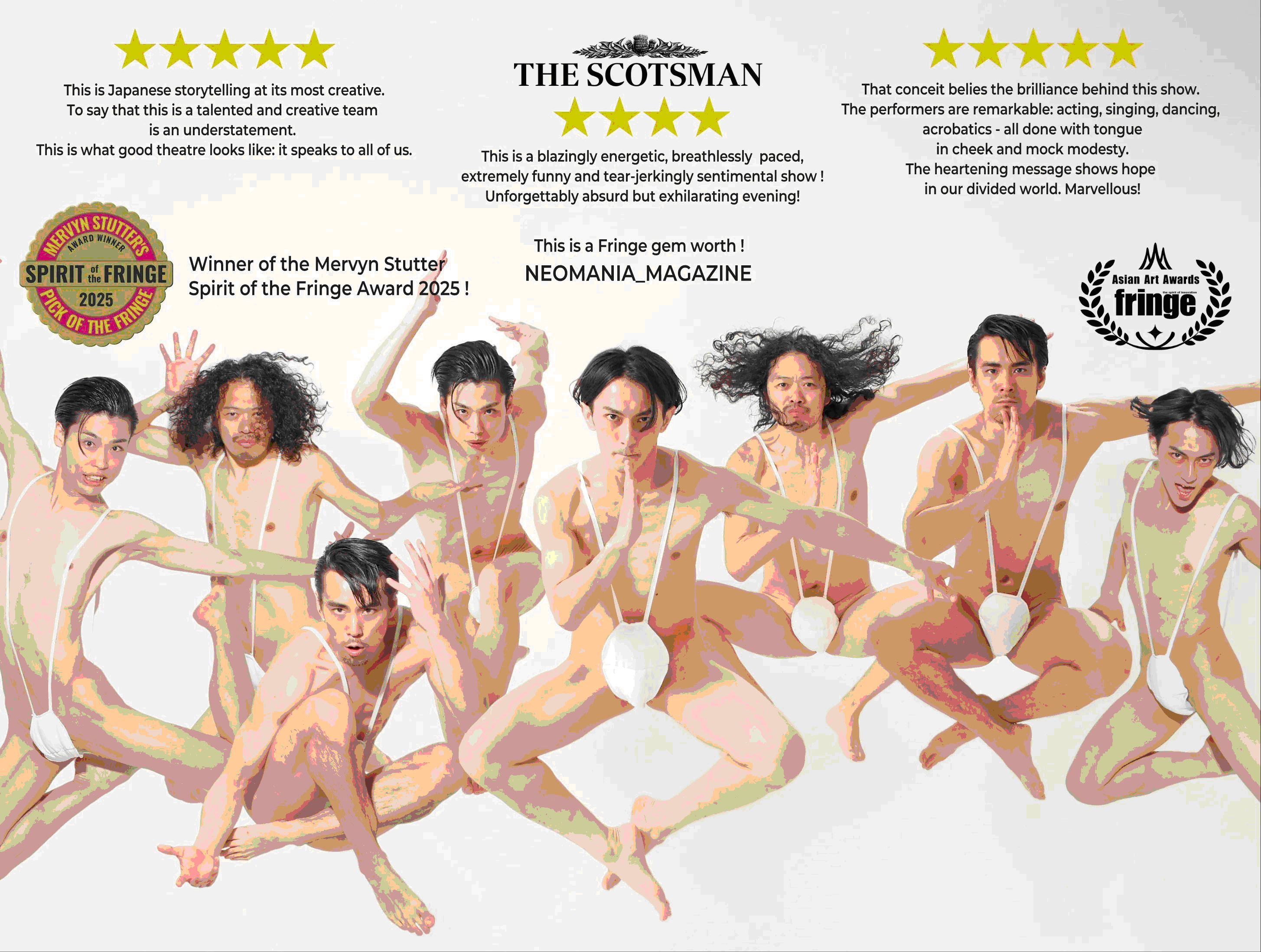
A spoofy retelling of the classic Night on the Galactic Railroad by children’s writer Miyazawa Kenji. The selling point here, as seen in the eye-catching poster, is the unusual costume design, nothing but a shoulder pad covering the performers’ neither regions. I’m always suspicious of shows relying on a gimmick, but it had strong reviews at this year’s Edinburgh Fringe Festival (not necessarily in itself the best indicator of quality) and, even better, was only an hour long. Continue reading

Suddenly Last Summer (1959 film), Suddenly Last Summer (1993 BBC)

  • Suddenly, Last Summer (1959 film), 7/2/25 (Wed)
  • Suddenly Last Summer (1993 BBC), 7/3/25 (Thurs)

I learned after watching Joseph L. Mankiewicz’s wild and starry movie version of Tennessee Williams’ one-act play, filmed only a year after its off Broadway debut, that the stage show itself was presented more or less unchanged on the BBC many years later. That comparison was too tempting to pass up.

Continue reading

Nagasaki: Memories of My Son (母と暮らせば , film), The Face of Jizo (父と暮らせば , film)

  • 母と暮らせば (Nagasaki: Memories of My Son, film), 7/26/25 (Sat)
  • 父と暮らせば (The Face of Jizo, film), 7/27/25 (Sun)

Having seen the stage versions of these shows in the past days, I was eager to catch the films. The Japanese titles, literally Living With Mother and Living With Father, make the connection clearer; they are set respectively in Nagasaki and Hiroshima just after the war and are considered part of a trilogy alongside Okinawa-based Army on a Tree.

Yamada Yoji’s 2015 Nagasaki actually preceded the stage show and I suppose is considered the original. However, it takes the material in a direction that veers significantly from Inoue’s vision as seen in the other two parts of the trilogy. Continue reading

Living With Mother (母と暮らせば), Soldiers in a Tree (木の上の軍隊)

  • 母と暮らせば (Living With Mother), 7/25/25 (Fri)
  • 木の上の軍隊 (Soldiers in a Tree), 7/25/25 (Fri)

Set respectively in Nagasaki and Okinawa, these are the final two dramas in what is considered Inoue Hisashi’s trilogy of post-war life along with Hiroshima-based Living With Father (aka The Face of Jizo), which I saw on stage last week. Today’s shows are archive films of the stage productions, shown as a special tribute on the 80th anniversary of the war’s end. The description “trilogy” is deceptive: while Inoue did plan the shows, his hugely popular Father of 1994, which became his signature piece, was the only one he actually wrote. The other two were picked up after his death based on his notes. Continue reading

The Face of Jizo (父と暮らせば)

    • 父と暮らせば (The Face of Jizo)

    7/16/25 (Wed)

    The classic piece by the prolific Inoue Hisashi about a woman in post-war Hiroshima with a bad case of survivor’s guilt who is visited by the ghost of her father. The immensely popular show, known in English as The Face of Jizo or more literally (and better) as Living With Father, has been revived at least 17 times in Japan in addition to numerous foreign-language productions (including a Japanese reading this month in NY) since its premiere in 1994 by Komatsu-za. That was directed as today by Uyama Hitoshi, so I assume this more or less follows the original staging. It’s being presented just a month before the 80th anniversary of the atomic bombing. It is the first in Inoue’s trilogy of post-war life along with Okinawa-based Army on a Tree, whose film version has just been released, and Nagasaki-based Living With Mother.

    We are in Hiroshima in 1948. A librarian who survived the atomic bombing through a quirk of fate is struggling with her memory of the horrors that she saw and her guilt for having lived despite the gruesome death of her friends and family. As she runs into the house terrified on a lightning-filled night, her father emerges from the closet to comfort her. We quickly gather that this is in fact the ghost of her father, who died in the bombing three years earlier.

    Continue reading

    Stereophonic

    • Stereophonic

    1/5/25 (Sun), Broadway

    I had hesitated to see this widely praised show, the most Tony-nominated play in history, because of the obscene fees tacked on to the ticket price on some sites. I eventually managed to find something closer to reasonable as the date got closer, but the whole process is exhausting. Worse, I overheard the guy directly behind me saying that he got his ticket for an even lower price for essentially the same seat. Something doesn’t feel right about that.

    The show, set in a Sausalito recording studio in the 1970s, is about the making of an album by a newly formed band combining a three-person British rock group with an American duo. That sounds an awful lot like Fleetwood Mac, though the writer denies it. In any case, the show not only covers the mechanics of creating an album but the dynamics among the players, where relationships already on the edge are being further frayed by the clash of egos. The problem is that musicians may be artists but are human too, and the ideal of leaving one’s musical mark for posterity can jar with the ephemeral emotional needs of the people involved.

    Continue reading

    A Look Back: Premium tickets: Don’t bring us your poor

    At this point, Broadway may as well rename itself Martha’s Vineyard. The NY Times reports this weekend that the still-previewing production of Othello with megastars Denzel Washington and Jake Gyllenhaal has a top price of $921 for a single seat and has attracted an average — average! — ticket price of $361.90. That’s before the show has even opened or been reviewed. Its lowest-priced ticket for full-view seats is $197, and even those seats are reportedly scarcer than usual.

    Yes, it’s a star vehicle, the producers are simply responding to demand, costs are high, there are other lower-priced shows, and so on. But basically this is a show for the rich; the rest of America need not apply. While it’s heartening in a way that Shakespeare can command the highest prices on Broadway, the message that this is sending is going to drive away a large segment of the population, an ominous development for the industry. People may go to specific shows, and tourists will always be there. But is there going to be anything like a theatergoing habit in the future? Producers have created a cost structure that is going to strangle them in the end. Continue reading

    Slave Play

    • Slave Play

    9/12/24 (Thurs), West End

    I had not planned on subjecting myself to what sounded like another diatribe on racism, but having told a friend to select whatever he’d like, I couldn’t complain. The result was predictable in its blame-the-whites attitude.

    The first half hour offers three scenes of interracial couples on a plantation in outrageous master-slave relationships, including whips and boot-licking. These turn out to be therapy sessions aimed at confronting the racism that is supposedly hurting their marriages. The couples – a women with a man who had initially been brought by her husband to spice up relations, a gay couple, and a seemingly normal couple – are brought together after their fantasy sessions to discuss their feelings with two therapists.

    The entire show reflects the racist attitude of the writer in assuming that the couples’ problems are rooted in racism, specifically from the white side. I’ve heard it all before; the writer is beyond redemption. I don’t feel a need to reflect on it, though I did enjoy the mocking pseudo-intellectual observations by the lesbian shrinks, which were quite funny. While it’s true that this is low-hanging fruit, I wish the rest of the show had been on that level.

    Continue reading