A look back: Pacific Overtures in Tokyo (太平洋序曲)
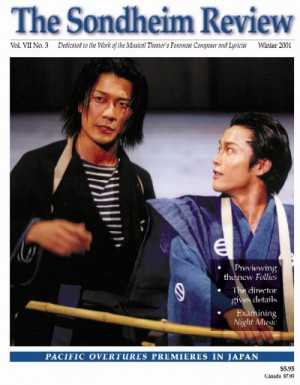
(I discovered that an article I wrote back in 2001 for the Sondheim Review (scroll down) is still available online, so I decided to link to it here. I discuss the innovative Tokyo production of the Japan-themed Sondheim musical Pacific Overtures, which later moved to Broadway in both Japanese and English versions. The latter was doomed by a poor choice of venue, though it did win a Tony nomination for Best Revival. Here are my thoughts on its Tokyo debut.
(UPDATE: An expanded version of this essay will be included in the Oxford Handbook of the Global Stage Musical, due out in November 2023.)
The idea of a Tokyo production of Pacific Overtures has something of a Victor/Victoria quality about it: a Japanese production of an American musical about the Japanese reaction to the arrival of Americans in Japan.
This is not quite like bringing a Japanese “Pearl Harbor Memories” to Honolulu, but it is true that the momentous changes that Commodore Perry’s arrival helped foment, a quaint story for Americans, are a vital part of the Japanese national identity. Indeed, many of the events and characters portrayed in the show – Japan’s self-imposed isolation from the world, Manjiro, the Tokugawa shogunate, the Meiji revolution and its consequences – are as familiar to any Japanese schoolchild as George Washington and the Revolutionary War are to Americans.
Even so, this is different from Americans enjoying a production of 1776. Because the show was written by Americans for American audiences, the different perspective makes a Japanese production a challenge in some unexpected ways. In October [2001], in a production directed by Amon Miyamoto, Pacific Overtures was given its Japanese premiere at The Pit, a 342-seat space in Tokyo’s New National Theatre.
It was an unquestioned critical and popular triumph for Stephen Sondheim and John Weidman, who attended the final performances, as well as the Japanese creative staff.
Moreover, it certainly shed new light on the show. Watching “Someone In A Tree,” the first-act song about varying perspectives, I had a sudden image of Harold Prince in a tree and Miyamoto under the floorboards, both looking at the script. In any event, judging from the video of the original Broadway production and the text (used in Tokyo) of the off-Broadway version, I can say that the Japanese show is a radical rethink.
Continue reading →
 sekenbanashi