A look back: Pacific Overtures in Tokyo (太平洋序曲)

A look back: Pacific Overtures in Tokyo (太平洋序曲)
v7n3-50-300x385

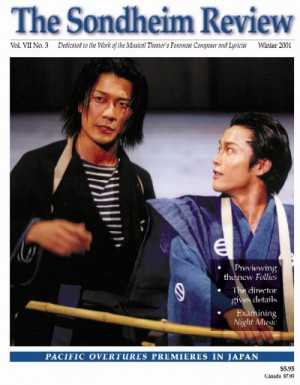
(I discovered that an article I wrote back in 2001 for the Sondheim Review (scroll down) is still available online, so I decided to link to it here. I discuss the innovative Tokyo production of the Japan-themed Sondheim musical Pacific Overtures, which later moved to Broadway in both Japanese and English versions. The latter was doomed by a poor choice of venue, though it did win a Tony nomination for Best Revival. Here are my thoughts on its Tokyo debut.

(UPDATE: An expanded version of this essay will be included in the Oxford Handbook of the Global Stage Musical, due out in November 2023.)

The idea of a Tokyo production of Pacific Overtures has something of a Victor/Victoria quality about it: a Japanese production of an American musical about the Japanese reaction to the arrival of Americans in Japan.

This is not quite like bringing a Japanese “Pearl Harbor Memories” to Honolulu, but it is true that the momentous changes that Commodore Perry’s arrival helped foment, a quaint story for Americans, are a vital part of the Japanese national identity. Indeed, many of the events and characters portrayed in the show – Japan’s self-imposed isolation from the world, Manjiro, the Tokugawa shogunate, the Meiji revolution and its consequences – are as familiar to any Japanese schoolchild as George Washington and the Revolutionary War are to Americans.

Even so, this is different from Americans enjoying a production of 1776. Because the show was written by Americans for American audiences, the different perspective makes a Japanese production a challenge in some unexpected ways. In October [2001], in a production directed by Amon Miyamoto, Pacific Overtures was given its Japanese premiere at The Pit, a 342-seat space in Tokyo’s New National Theatre.

It was an unquestioned critical and popular triumph for Stephen Sondheim and John Weidman, who attended the final performances, as well as the Japanese creative staff.

Moreover, it certainly shed new light on the show. Watching “Someone In A Tree,” the first-act song about varying perspectives, I had a sudden image of Harold Prince in a tree and Miyamoto under the floorboards, both looking at the script. In any event, judging from the video of the original Broadway production and the text (used in Tokyo) of the off-Broadway version, I can say that the Japanese show is a radical rethink.

Continue reading

All Nudity Shall Be Punished (禁断の裸体)

  • 禁断の裸体 (All Nudity Shall Be Punished)

4/18/15 (Sat), Tokyo

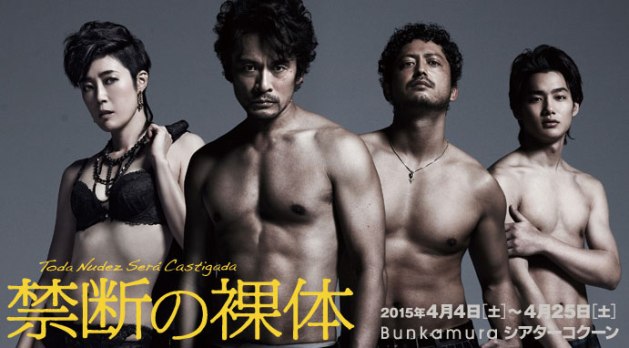
150418kindan1 I knew nothing at all about this play, but the poster art was eye-catching, to say the least, and a bit of research indicated that it was a famous (or infamous) show by one of Brazil’s best known playwrights, Nelson Rodrigues. It also starred the great Shinobu Terajima, who was so memorable in the film Caterpillar, and Seiyo Uchino, a well known stage actor. Tickets were hard to come by, which made me all the more curious to see it. I wasn’t able to find much information on the show, so I had no idea what I was getting myself into.   Continue reading

Hamlet (NT Live)

  • Hamlet (NT Live)

8/3/17 (Thurs), Tokyo

An encore showing of the Barbican production, filmed by the National Theatre people. This Hamlet had broken records not only on stage but in its NT Live incarnation at movie theaters two years ago thanks to the popularity of megastar Benedict Cumberbatch as the lead. While I don’t get the sex symbol thing at all, he was excellent as the monster in the NT’s Frankenstein some years back (also a sellout here in Tokyo), and I’m impressed at any TV/film star who’s willing to put himself out there in a challenging role like this.  Continue reading

A look back: Tokyo’s Prince of Broadway

A look back: Tokyo’s Prince of Broadway

I see they’re going ahead with Prince of Broadway, the long-aborning retrospective of producer/director Harold Prince’s estimable career in the theater. While noting (and hoping) that the show may have been dramatically transformed since then, I recall that the preliminary version that played in Tokyo in October 2015, reviewed here, was mainly a succession of I-produced-this-I-directed-that musical scenes plucked from his various shows and recreated with little or no context. It was like a Wikipedia entry on stage, a list of disembodied names and songs. As I noted then:

The numbers are nearly all famous songs presented with costumes and scenery reminiscent of their shows but no background whatsoever. So we get an old guy with a milk cart wishing he were rich, a painted emcee welcoming us to a nightclub, a woman in a chair pouting about clowns, a gravelly voiced woman who wants to propose a toast, a man in a prison cell babbling about dressing up mannequins, and so forth. Not remotely interesting to anyone who doesn’t know these shows and songs…and not particularly interesting to me, a big musical buff who’s seen this all before.

Continue reading

New York (March 2015)

New York (March 2015)

  • Semele, 3/8/15 (Sun), BAM
  • The Audience, 3/10/15 (Tues), Broadway
  • On the 20th Century, 3/11/15 (Wed), Broadway
  • Honeymoon in Vegas, 3/11/15 (Wed), Broadway
  • An Octoroon, 3/18/15 (Wed), Off Broadway
  • An American in Paris, 3/19/15 (Thurs), Broadway
  • Paint Your Wagon, 3/20/15 (Fri), Encores!
  • The King & I, 3/21/15 (Sat), Lincoln Center
  • On the Town, 3/21/15 (Sat), Broadway
  • Finding Neverland, 3/22/15 (Sun), Broadway

Continue reading

Much Ado About “Comet”

  • Much Ado About Comet

A producer trying desperately to save a sinking show removes a relatively unknown actor (with full compensation) in exchange for a major box office draw. Seems straightforward enough.

Now try it again: A producer trying desperately to save a sinking show removes a relatively unknown black actor (with full compensation) in exchange for a major Caucasian box office draw. If that sounds different to you, then the problem may be you.  Continue reading

Phantom of the Opera (Japanese)

  • オペラ座の怪人 (Phantom of the Opera)

7/22/17 (Sat), Yokohama

I hadn’t seen the stage version of Phantom since Las Vegas in 2007 (and before that in NY in 1997 – there’s a pattern there). This was the first time to catch the massively successful Japanese version. I was invited by a friend who’s seen the show, by his estimate, around 120 times (!!) and had secured extra tickets for this sold-out-as-usual run. The Shiki Theatre Company, the keeper of the Japanese version, has multiple casts in the main roles and, to prevent a bias in sales toward the more popular performers, doesn’t announce which cast is appearing until a week in advance, way too late to score tickets. Pretty slimy. (Shiki’s uncomplaining fans, like my friend, simply buy tickets for multiple performances in hopes of landing their preferred actor/actress.) Unfortunately for my friend, the phantom this time was his fourth choice among the five playing the role. But the rest of us were happy just to be there.  Continue reading

Kabuki: Daemon and the Flower Palace (駄右衛門花御所異聞)

  • Kabuki: 駄右衛門花御所異聞 (Daemon and the Flower Palace)

7/18/17 (Tues), Tokyo

This is a rarely seen drama about the real-life gangster Nippon Daemon first produced in 1761 (under the name Akiba Gongen Kaisen Banashi) and apparently drastically rewritten for Ebizo. More accurately, it has been reworked as a vanity piece for the star. A villain has stolen a precious manuscript and magical religious heirloom from a noble family in hopes of toppling it and taking over the country. The rest hardly matters.  Continue reading

Onibaba (鬼婆)

  • 鬼婆 (Onibaba)

7/11/17 (Tues), DVD

This singular 1964 film by Shindo Kaneto about two country women scraping out a life in the turmoil of 14th-century Japan was described to me as a horror flick, but that description doesn’t seem quite right. Horror can be easily forgotten once the thrill is over. That is not the case with this movie.  Continue reading

The Deep Blue Sea (1955 film)

  • The Deep Blue Sea (1955 film)

7/8/17 (Sat), Tokyo

My second viewing of last year’s National Theatre production the previous day inspired me to seek out the old film version, which appeared just a few years after the original 1952 stage show and was scripted by Rattigan himself. (There are also several BBC television adaptations, most recently in 1994, and a bizarre film deconstruction from 2011 that I turned off after five minutes.) This first film stars Vivien Leigh, just coming off Streetcar, as well as the original stage performer Kenneth More as the lover Freddie.  Continue reading