With the recent release of the film version of Oslo on HBO, I thought it worth revisiting my brief thoughts on the stage version at Lincoln Center some years back during a trip to New York. I missed the Japanese version at Tokyo’s New National Theatre back in February. I was wondering how the general lack of knowledge here about (or interest in) Middle Eastern affairs might affect the characterizations; even accents are rarely used to distinguish varying nationalities, i.e., everyone speaks standard Japanese, sometimes making it hard to figure out who is who. It apparently sold well, helped by a starry cast, so hopefully there will be revival at some point. Continue reading
Utamaro and His Five Women (歌麿をめぐる五人の女 )
- 歌麿をめぐる五人の女
6/7/21 (Mon)
Mizoguchi Kenji’s 1946 work on the famed ukiyoe artist was evidently one of the first movies to be approved after the war by the American occupying forces. Mizoguchi is widely said to have seen himself in the story of the devoted artist, which here involves censorship and female issues, but the same can probably by said for any film about a struggling artist from Lust for Life onwards. Given the director’s usual concern with the difficulties of women in Japanese society, I had assumed the female half of the title would be the film’s centerpiece.
In fact, though the five women dominate the narrative, the thematic focus is Utamaro’s obsession with his art. Continue reading
The Insect Woman (にっぽん昆虫記)
- にっぽん昆虫記 (The Insect Woman)
6/6/21 (Sun)
After Imamura Shohei’s previous work, the madcap Pigs and Battleships, I was ready for anything. This 1963 film – the literal Japanese title is a more clinical Chronicle of Japanese Insects – followed an effective two-year ban of the director by Nikkatsu for his over-the-top and over-the-budget Pigs. Still, Imamura, unbowed, held nothing back in his new piece about a ruthless woman who does whatever she can to survive. The brutal results ironically became the biggest-grossing film in his career, which presumably mollified the studio’s concerns.
Pigs and Battleships (豚と軍艦)
- 豚と軍艦 (Pigs and Battleships)
6/1/21 (Tues)
The wild 1961 film that put director Imamura Shohei on the map (and got him banned from studio for two years). It’s a black comedy mixed with social satire about Japanese civilians and American sailors in Yokosuka, a coastal town near Tokyo that hosts a major US naval base, around 1960.
The Cremator (Spalovač mrtvol)
- Spalovač mrtvol (The Cremator)
5/19/21 (Wed)
Juraj Herz’s long-banned film of 1969 was part of the Czech New Wave, which largely disappeared when Soviet tanks rolled into Prague the previous year. The setting is the 1930s just ahead of the Nazi takeover of the country. The head of a crematorium adheres to the Tibetan teaching that death helps end human suffering and open the way to a new future life, making him feel good about preparing people for their end – both the dead bodies entrusted to him and the living humans that he took it upon himself to “liberate”. Continue reading
Black Orpheus (Orfeu Negro)
- Orfeu Negro (Black Orpheus)
5/14/21 (Fri)
This film actually won an Academy Award?? A bit of exotica from 1959 surrounding a love affair in a Rio favela during Carnival based on the Orpheus-Eurydice legend. Continue reading
Closely Watched Trains (Ostře sledované vlaky)
- Ostře sledované vlaky (Closely Watched Trains)
5/11/21 (Tues)
A 1966 Czech film by Jiří Menzel set in a small Czech town toward the end of the war. Continue reading
The Shop on Main Street (Obchod na korze)
- Obchod na korze (The Shop on Main Street)
5/9/21 (Sun)
I was browsing through Criterion’s selection of Best Foreign Language Oscar winners and chose this 1965 Czechoslovakian film by Ján Kadár and Elmar Klos without knowing much about it. It turned out to be a Holocaust comedy, not a crowded category, set in 1942 in the newly created Nazi puppet state of Slovakia. The Tiso regime has accepted the Nuremberg Race Laws, setting off the conflict that drives the drama.
Zero Focus (ゼロの焦点)
- ゼロの焦点 (Zero Focus)
4/29/21 (Thurs)
An amateurish murder mystery from 1961, based on a popular book, that wouldn’t pass muster even as a daytime television film. A woman is just a week into her arranged marriage when her husband mysteriously disappears. He is found dead at the bottom of a cliff, an incident that is ruled a suicide – but is it? The women comes to find that there is more to her husband’s past than she had imagined.
Children of the Beehive, The Hairpin, Mr. Thank You (蜂の巣の子供たち、簪、有難うさん)
- 蜂の巣の子供たち (Children of the Beehive), 4/25/21 (Sun)
- 簪(かんざし)(The Hairpin), 4/27/21 (Tues)
- 有難うさん (Mr. Thank You)、4/27/21 (Tues)
Three films by the unjustly neglected Shimizu Hiroshi. Continue reading
Essay: Brief history of Kabuki theater
The year was 1603. By an historical quirk, on the very same calendar day (March 24*) that Queen Elizabeth I died and King James VI of Scotland ascended to the English throne, Japan’s Tokugawa Ieyasu received the title of shogun from the Emperor after his crushing victory on the battlefield three years earlier, marking the start of an unprecedented period of political stability in Japan known as the Edo Era. In that same year, while Shakespeare was penning Othello, Cervantes was working on Don Quixote and England’s first permanent settlement in the Americas was still four years in the future, a woman named O-Kuni danced on the shores of the Kamo River in Kyoto and inadvertently planted the seeds for Kabuki theater.
A Kabuki Christmas Carol
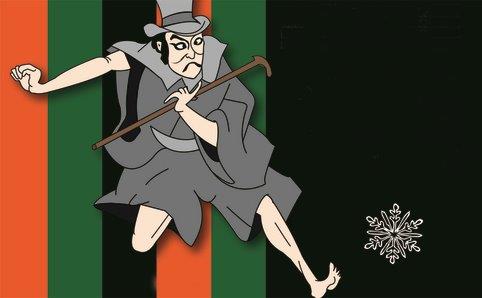
This is my Kabuki version of the Dickens classic reset in late 19th-century Japan. That setting is deliberate: Scrooge’s youth would be the Edo Era of samurai and shoguns; his present the Meiji Era, when Japan opened itself to the world; and his future the increasingly Westernized Late Meiji or Taisho Era, all visually very distinct periods. I originally wrote the show in Japanese for a Kabuki script competition by Japan’s National Theatre. That didn’t work out, but when a local English-language troupe took interest, I rewrote it in English. The show takes place on a Japanese New Year’s Eve, which shares many similarities with Christmas Eve in the West, but the producer insisted on retaining the “Christmas Carol” title for marketing purposes (the Japanese title is different). The production, performed in English by a multicultural cast at a central Tokyo theater, proved a huge success in a sellout run. The image above was created for that production. Here is a slightly revised version of that script.
**PERFORMANCE RIGHTS ARE RESERVED. FOR INQUIRIES, PLEASE CONTACT THE AUTHOR OF THIS BLOG.**
 sekenbanashi