- 野菊の如き君なりき (Like a Wild Chrysanthemum), 3/21/18 (Wed)
A melancholic 1955 film of young love by Kinoshita Keisuke, director of the uber-sentimental smash Twenty-Four Eyes. Continue reading
A melancholic 1955 film of young love by Kinoshita Keisuke, director of the uber-sentimental smash Twenty-Four Eyes. Continue reading
10/4/17 (Wed), Tokyo
I was curious about this 1977 movie after seeing the excellent puppet version, which was based on this source rather than the original play or novel. The director, Shinoda Masahiro, was also behind the muddled curiosity Double Suicide.
The story revolves around a lonely wandering blind singer who falls in love with a soldier. While he is clearly devoted, he refuses strangely to engage with her sexually, a source of great frustration to her. Still, she takes happiness where she can. The reasons for his unusual behavior are revealed in a tragic ending.
More than a dozen years after its debut in London, the stage production of Mary Poppins is finally making its way to Tokyo in an all-Japanese version this month. The show ran only around three years in London, a considerable disappointment given the potency of the title and the pedigree of mega-producers Disney and Cameron Mackintosh. It posted a stronger and profitable run of over six years on Broadway, but never became the iconic hit that many had envisioned.
My review of the London production from September 2005, when the show was still in its first year, says it all, so I’ll repeat that here.
2/16/18 (Fri), Tokyo
A friend was suddenly unable to attend and asked me to escort his date. It didn’t take much to convince me: this was the second month of a two-month name-taking celebration for three generations in the Matsumoto acting family, the first such occurrence in 37 years, and tickets had been sold out well before the show opened. The atmosphere was electric. Koshiro has taken the name Hakuo, Somegoro has become Koshiro, and Somegoro’s 12-year-old son Kintaro is now Somegoro. It’s going to take a while to get used to that.
Bunraku
Shinju Yoi Goshin (Double-Suicide on Koshin Eve): The penultimate show in the great Chikamatsu Monzaemon’s long career and his final sewamono (home drama), staged in 1722. It was based on an actual double-suicide that occurred, according to one source, only two weeks (!) earlier, though as usual interpreted creatively by the author. It apparently competed with another show staged simultaneously by his erstwhile rival Ki no Kaion on the same theme – they worked fast in those days. (Another source puts the actual suicide in the previous year, which would make more sense.) The production today didn’t include the curious first act, where Hanbei chooses a suitor for his younger brother – all males lusting after a male companion with surprising words of passion. The suitors point out that the castle town in the play doesn’t have any laws against this as exist elsewhere, and neither brother seems to have a problem with the boy becoming effectively a male wife. Hanbei chooses one who is willing to make a noble sacrifice. An interesting footnote in gay Japanese theater, if such a genre exists.
4/10/13 (Wed), Tokyo
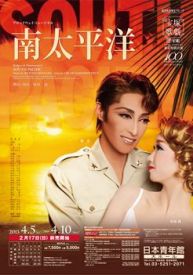
At first glance, South Pacific seemed the least likely of the big Rodgers and Hammerstein musicals to be given the Takarazuka treatment given the high macho factor: “There’s Nothing Like a Dame” has a whole chorus of men grumbling about the lack of women, “Younger Than Springtime” calls in the script for a shirtless guy (implying some off-stage fun), and “Honey Bun” features a man in drag with coconuts for boobs. Also, the theme of racial discrimination wouldn’t resonate whatsoever with this group’s core audience. More than that, the text states explicitly that the soldiers are there to fight the Japanese, which no one in this country wants to hear about. (In the last version I saw in Tokyo, an import from London, the subtitles used katakana, the alphabet used for foreign words, for all references to the Japanese military (ニホン軍) as if Japan were a foreign country.) But, of course, it’s a big romantic story with two juicy male leading roles, an ideal combination for these guys (girls), and the super-maleness was certainly a prime attraction for me. There was no way I was going to miss this opportunity to catch some high camp.
With the death of the great Takamine Hideko at year-end, I gathered friends to watch one of her most successful films. It is an unabashedly sentimental piece from 1953 about a new teacher and her 12 charges in a poor village in Shodoshima over a 20-year span from 1928-1948, i.e., before, during and after the war.
Ichikawa Kon’s 1958 film version of Mishima’s then-recent novel Kinkakuji (The Golden Pavilion), a fictionalization of the notorious incident just a few years earlier when a crazed monk burned down the centuries-old structure. The novel is filled with ruminations about the nature of beauty versus reality by a narrator isolated from society by his own insecurities over his crippling stutter. His image of Kinkakuji (called here by a different name), described by his father as almost other-worldly, sets him up for a devastating letdown when he encounters the actual dilapidated structure. The temple in his mind represents an ideal that, when violated, prompts him to destroy the former to protect the latter.
The film can’t begin to compete at that level, but it is a dutiful recounting of the main events and is highly effective on its own terms. Continue reading
1/27/18 (Sat), Tokyo
The latest rendering of Mishima’s overwrought, exceedingly talky but highly popular detective drama of 1962. I saw the traditional shingeki version ten years ago with the sleek villainess played by the legendary Miwa Akihiro, Mishima’s own choice for the film version (and supposed lover), and came out unsure whether I was seeing a serious rendering or a parody. This time was a new production by the celebrated British director David Leveaux, who, less tied to the old ways, would presumably be coming to the material with fresh eyes. I was also encouraged by good reviews by friends. The production was completely sold out throughout the run, but I managed to grab two day seats.
4/16/17 (Sun), Umewaka Noh Theater, Tokyo
This was a nice pairing of shows since both, in a seasonal touch, were set in the cherry blossoms. They were also both explicitly religious and offered fast-paced kakeri (described somewhere as “anguish dances”).
I was particularly interested in Tamura since, unlike the typical laments by felled soldiers, it’s one of only three warrior pieces in Noh that are about winners. (I saw another, Yashima, just a few months earlier.) This play is also unusual among the warrior shows in that it is not about one of the 12th-century Heike battles but an event that comes several hundred years earlier. Continue reading
4/5/17 (Wed), Yasukuni Shrine
The cherry blossoms were in full glorious bloom for Yasukuni Shrine’s annual outdoor Noh series this year, so the setting was magnificent. Gensho, a National Living Treasure, had played the previous night in the wonderful Saigyozakura (西行桜), but I opted for tonight since it was a play I hadn’t seen. My friend was late, so I missed the torch lighting and had to watch the opening dance from the back. Grr.
The Noh piece, Youchi Soga, has an unusual pedigree. The author Miyamasu is a contemporary of the pioneering Zeami, but while the latter went all aristocratic once the shogun took him in, the former continued to write common man’s Noh – not a genre I was even aware of. His plays apparently are nearly all genzai plays featuring living people as opposed to ghosts, with actual plots and lots of characters. A good number are about the Soga brother vendetta that also features so prominently in Kabuki.
3/7/17 (Tues), Tokyo
Amon Miyamoto, who brought his maverick (and Tony-nominated) production of Pacific Overtures to Broadway some years back, is the go-to director for Sondheim musicals in Japan, but I was still surprised to hear that he was tackling this pure farce versus the more pseudo-serious shows that he prefers. It made more sense once I realized that he’s given it a twist: he’s changed the setting from ancient Rome to Edo, the name for present-day Tokyo through the mid-19th century. This is the first time I know of that Sondheim has permitted a fundamental change like this in any of his shows throughout his long career. (I understand that he’s also given the okay for a Company in the UK using a female lead.) Maybe he’s getting more mellow in his old age. I had assumed that this was one of Miyamoto’s wacky ideas but was surprised to learn that it came from Sondheim himself (a friend of Miyamoto’s since happening upon Pacific in Tokyo in 2000) at the suggestion of Japanese writer Aoshika Koji, who translated the script alongside Miyamoto’s lyrics.
 sekenbanashi