Hana-Bi

  • Hana-Bi

6/24/15 (Wed)

I wasn’t wild about the idea of a Kitano (“Beat”) Takeshi film given its reputation for over-the-top violence, but Hana-Bi is one of several flicks by him – “by” in a big sense, meaning directed, written and starring – that are widely considered modern classics, especially overseas. So I figured it was about time to check it out.   Continue reading

Silent films: Kid Commotion, The Dawning Sky (子宝騒動、明け行く空 )

  • Silent films: 子宝騒動、明け行く空 (Kid Commotion, The Dawning Sky)

5/19/15 (Tues), Tokyo

These were silent films by Torajiro Saito, evidently known in his day as film studio Shochiku’s “king of comedy”. They were narrated by a female benshi, Akiko Sasaki, who sat at the side of the screen and voiced all the roles as well as narrating non-dialogue sections in her own words. The music was newly composed and played live on a keyboard. The setup directly recalled (and perhaps stemmed from) Japan’s Bunraku puppet theater, where the narrator and musician sit in full view of the audience on a raised platform beside the stage and give voice to the voiceless puppets. The mixture of film and live performance seemed very modern somehow, so it’s interesting to note that Japan was doing it nearly a century ago.   Continue reading

Sugimoto Bunraku: The Oil Hell Murder (杉本文楽:女殺油地獄)

  • 杉本文楽:女殺油地獄 (Sugimoto Bunraku: The Oil Hell Murder)

8/13/17 (Sun), Tokyo

This was a second crack at modernized Bunraku by the renowned photographer and artist Hiroshi Sugimoto. The first, which I saw almost exactly six years ago, was a fuller-than-usual version of the ever-popular Love Suicide at Sonezaki. That show incorporated scenes that hadn’t been performed in centuries, juggled the usual placement of singers and musicians on stage, and experimented with lighting and (naturally) photographic and video projections, among other innovations. Unfortunately, it fell victim to a hall far too large for a puppet drama, chosen presumably to pay for all that elaborate staging; Sugimoto’s many fans got their money’s worth, but Bunraku fans were left short changed. Still, the staid world of Bunraku can stand some shaking up, and the production had some worthwhile ideas. So I was looking forward to what he would do this time, especially in this smaller, more puppet-friendly theater. He chose another of Chikamatsu Monzaemon’s big hits, which centers on the brutal murder of a young woman by a heavily indebted youth.

Continue reading

A look back: Pacific Overtures in Tokyo (太平洋序曲)

A look back: Pacific Overtures in Tokyo (太平洋序曲)
v7n3-50-300x385

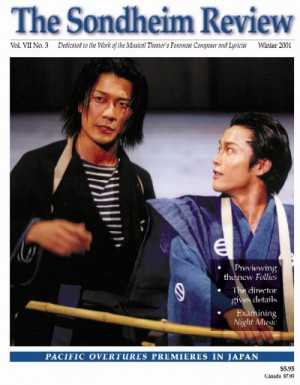
(I discovered that an article I wrote back in 2001 for the Sondheim Review (scroll down) is still available online, so I decided to link to it here. I discuss the innovative Tokyo production of the Japan-themed Sondheim musical Pacific Overtures, which later moved to Broadway in both Japanese and English versions. The latter was doomed by a poor choice of venue, though it did win a Tony nomination for Best Revival. Here are my thoughts on its Tokyo debut.

(UPDATE: An expanded version of this essay will be included in the Oxford Handbook of the Global Stage Musical, due out in November 2023.)

The idea of a Tokyo production of Pacific Overtures has something of a Victor/Victoria quality about it: a Japanese production of an American musical about the Japanese reaction to the arrival of Americans in Japan.

This is not quite like bringing a Japanese “Pearl Harbor Memories” to Honolulu, but it is true that the momentous changes that Commodore Perry’s arrival helped foment, a quaint story for Americans, are a vital part of the Japanese national identity. Indeed, many of the events and characters portrayed in the show – Japan’s self-imposed isolation from the world, Manjiro, the Tokugawa shogunate, the Meiji revolution and its consequences – are as familiar to any Japanese schoolchild as George Washington and the Revolutionary War are to Americans.

Even so, this is different from Americans enjoying a production of 1776. Because the show was written by Americans for American audiences, the different perspective makes a Japanese production a challenge in some unexpected ways. In October [2001], in a production directed by Amon Miyamoto, Pacific Overtures was given its Japanese premiere at The Pit, a 342-seat space in Tokyo’s New National Theatre.

It was an unquestioned critical and popular triumph for Stephen Sondheim and John Weidman, who attended the final performances, as well as the Japanese creative staff.

Moreover, it certainly shed new light on the show. Watching “Someone In A Tree,” the first-act song about varying perspectives, I had a sudden image of Harold Prince in a tree and Miyamoto under the floorboards, both looking at the script. In any event, judging from the video of the original Broadway production and the text (used in Tokyo) of the off-Broadway version, I can say that the Japanese show is a radical rethink.

Continue reading

All Nudity Shall Be Punished (禁断の裸体)

  • 禁断の裸体 (All Nudity Shall Be Punished)

4/18/15 (Sat), Tokyo

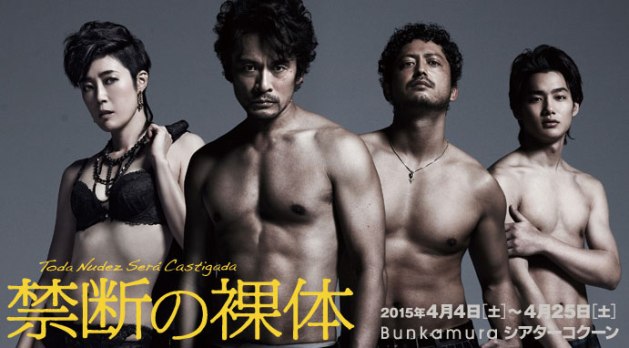
150418kindan1 I knew nothing at all about this play, but the poster art was eye-catching, to say the least, and a bit of research indicated that it was a famous (or infamous) show by one of Brazil’s best known playwrights, Nelson Rodrigues. It also starred the great Shinobu Terajima, who was so memorable in the film Caterpillar, and Seiyo Uchino, a well known stage actor. Tickets were hard to come by, which made me all the more curious to see it. I wasn’t able to find much information on the show, so I had no idea what I was getting myself into.   Continue reading

Kabuki: Daemon and the Flower Palace (駄右衛門花御所異聞)

  • Kabuki: 駄右衛門花御所異聞 (Daemon and the Flower Palace)

7/18/17 (Tues), Tokyo

This is a rarely seen drama about the real-life gangster Nippon Daemon first produced in 1761 (under the name Akiba Gongen Kaisen Banashi) and apparently drastically rewritten for Ebizo. More accurately, it has been reworked as a vanity piece for the star. A villain has stolen a precious manuscript and magical religious heirloom from a noble family in hopes of toppling it and taking over the country. The rest hardly matters.  Continue reading

Onibaba (鬼婆)

  • 鬼婆 (Onibaba)

7/11/17 (Tues), DVD

This singular 1964 film by Shindo Kaneto about two country women scraping out a life in the turmoil of 14th-century Japan was described to me as a horror flick, but that description doesn’t seem quite right. Horror can be easily forgotten once the thrill is over. That is not the case with this movie.  Continue reading

The Rat Burglar (鼠小僧)

  • Kabuki: 鼠小僧  (The Rat Burglar)

3/6/15 (Fri), film

I managed to get myself switched to an All Nippon Airways flight to New York when my United flight was suddenly cancelled. One advantage was a good selection of Japanese films, and I was surprised to see some Kabuki selections. I had avoided this particular 2003 production before since I didn’t want to spend money on Noda Hideki, who wrote and directed it. But it was a big hit, and I figured it wouldn’t hurt to know what was out there. And at free, the price was right.  Continue reading