- 太平洋序曲 (Pacific Overtures), 3/12/23 (Sun), Tokyo
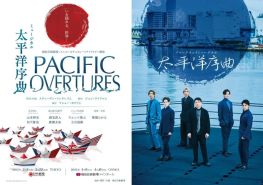
British director Matthew White doesn’t let the script get in the way of his vision in his Japanese-language version of Pacific Overtures, a co-production between London’s Menier Chocolate Factory and Osaka’s Umeda Arts Theater that debuted in Tokyo a few days ago. He makes his ideas clear in his statement on the show’s website: “At a time when my own country, through Brexit, has opted to isolate itself from its European neighbors, I find it both fascinating and enlightening to investigate a period in recent history when Japan came to the opposite conclusion – that the only sensible option was to engage with the rest of the world to embrace new technologies and to demonstrate that anything the West could do, Japan could do better.”
He doesn’t note that Japan’s decision was forced upon it by the overt threat of military force from the Western powers, resulting in civil war, a wholesale upheaval of society, and the rise of a military regime that led the nation ultimately to disaster. The show’s original ending features a touching twinge of regret for a lost innocence, questioning whether the nation’s choices have been all for the good. The only other Tokyo production of this show some two decades ago, helmed by a Japanese director, enhanced that with a scene alluding to the nation’s unhappy experience in WWII to highlight the high price it has paid for its actions. That’s without mentioning that Japan has managed to engage with the world even with its Westernized ways without compromising its independence. The show seems a strange place to preach the evils of Brexit.
The musical opens in the mid-19th century in samurai-era Japan, which has kept itself closed off for 250 years from the outside world. A minor official, Kayama, is charged with getting rid of four pesky American warships that have appeared on Japanese shores with demands that the nation open its doors to foreign trade. The official takes along a convicted criminal named Manjiro, a real-life fisherman (known affectionately in Japan as John Manjiro) who had spent time in America after being rescued at sea. Their efforts appear at first to succeed in preserving the nation’s isolation, but Japan learns that it cannot fight the tide of history as the Western powers successively move in. The centuries-old shogunate is toppled, and the new government decides to fight fire with fire by turning away from the old ways and rapidly industrializing and militarizing, a process shown by the Westernized Kayama winning over the increasingly tradition-oriented Manjiro. The show jumps at the end into present-day Japan, where we are left to ponder what these changes have wrought.
White has compressed the show into an intermission-less 110 minutes, lopping off certain scenes and an entire song (the admittedly extraneous “Chrysanthemum Tea”) along the way. He presumably had help from the script’s author, John Weidman, who was there on opening night; this might have been based on the stripped-down version by another British director, John Doyle, staged in New York six years ago.
The show opens interestingly at a museum exhibition with showcases displaying a doll, a model of a hut, and other items that will prove symbolic in the story. The narrator here is not a storyteller but a lecturer, speechifying about Japan to visitors in Western dress who emerge drinking wine and examining the displays. (The advertising for the show features all actors in contemporary Western clothing.) The opening lines are thus not from the perspective of someone in the moment but from a total outsider. While the visitors gradually exit and reappear in period dress for the story proper, the narrator remains a modern Westernized presence throughout the show as if the entire story is a museum piece, delivering his lines seriously and straightforwardly. Until he transforms at the end into Emperor Meiji, he could have been a voiceover.
White has a nicely unfussy approach and keeps the pace swift, but he is much too reverent with material that doesn’t always justify it, sapping away much of the humor. He has some interesting staging ideas such as the small boats sailing through “Four Black Dragons” and an amazing set (see below), but by and large the show feels undernourished. The musical is problematically driven less by character than by concept, with several scenes featuring songs and one-off roles (“Chrysanthemum Tea”, “Welcome to Kanagawa”, “Pretty Lady”) that contribute more or less thematically but could easily be dropped with no loss to the narrative. That puts a lot of burden on the director to pull it all together and make us care about the characters that do count.
Whether he succeeds here is questionable. Kayama, the closest to a lead role along with Manjiro, should not be singing “There Is No Other Way” even with the shift in the Japanese lyrics. The words, usually voiced in the show by outside singers, sound trite coming from a samurai, who would be expected to behave more stoically. His state of mind would be better expressed in creative staging, but here he simply wanders aimlessly. He does not come off well.
Some other staging ideas are also curious: the old man in “Someone In a Tree” enters in a wheelchair and ends up somehow up a tree, while the three sailors in “Pretty Lady” push the woman down and come close to raping her in broad daylight, which actually justifies their murder. On the other hand, the “March to the Treaty House” and “Please Hello” had a nice sense of fun that was missing elsewhere, and “A Bowler Hat”, the show’s most important number, was well done.
One problem was casting. Having a woman play the role of shogun felt lightweight. I know that we’re supposed to imagine a deep voice and imposing presence, but I’d rather the actor did that for me at these prices. The character just sounded weak. On the other hand, casting females as the courtesans in “Welcome to Kanagawa” proved problematic in a different way. The women’s bawdy movements came off as vulgar, which wasn’t to the taste of the largely female audience judging from their non-reaction. The number got big laughs in the last Japanese production, where the use of men as the madam and several of the girls injected a layer of unreality that allowed for exaggeration; here, it played to silence. I can understand the director wanting to include more actresses given the scarcity of big female roles in the show and the gender pressures in the UK, but I wish he were more sensitive to the needs of viewers here.
The rise of Meiji is followed immediately by a flash of modern designs and images projected on the back wall as the cast, back in Western dress, segues into “Next”, as if Japan rode smoothly into its future after its opening to the world. If only. Japanese know their own history too well to exclude the difficult intervening years of wartime sacrifice and postwar devastation and poverty, and the last Japanese production addressed this directly as if asking if the heavy cost was worth it, particularly for the materialistic Western society that eventually emerged. (Composer Stephen Sondheim gave particular praise to that segment for solving a problem that he had been unable to resolve in the original production.) White does not include the ironic listing of facts meant to represent empty material progress (e.g., “Japan produces XX percent of the world’s XX!”), and notably does not bring back the fisherman and wife as the bygone symbol of a more idyllic Japan as in the original script’s evocative ending. He seemed to imply rather that modernization and globalization (via Western intervention) have been an unquestioned force for good in Japan, a message diametrically opposed to that in other versions, particularly the Japanese-directed show. He has to do some serious manipulation of the text – and history – to make his point.
Paul Farnsworth’s inventive set features stairs leading to a platform, backed by a large circular space cut in the wall that opens upward or sideways to reveal numerous settings, from an ukiyoe picture of Mt Fuji to the arrival of the black ship in silhouette to entire scenes with the shogun. Floor-to-ceiling panels slide in on fixed tracks in dynamic configurations. It used a minimalist approach with no drops or other major set pieces, allowing for fluid scene transitions. Combined with Yasuyuki Yoshieda’s skillful lighting, that was easily the best part of the show. I can see an Olivier Award in this guy’s future. Ashley Nottingham’s choreography, though not particularly Japanese, was low-key and effective. (One newspaper review said the choreographer’s use of fans made him laugh, though I’m not sure that was the intended effect.) Maeda Ayako’s period costumes were authentic for the Japanese and playful for others – loved the little boats worn by the Western diplomats – but why the freshly pressed US sailor suit for a guy who’s just emerged from a Japanese prison? And I hope that she wasn’t the one responsible for giving a modern convenience-store umbrella to the 19th-century samurai in “Poems”.
While there were no standouts in today’s group (the main roles are double cast), the overall level of the acting and especially the singing was solid. One exception was the narrator, who, maybe hamstrung by the role’s concept as an outsider, was distant and made little impression. His hectoring delivery made the numerous haiku, for instance, fall flat. The woman playing the double role of shogun and brothel madam was also an unfortunate choice for reasons not necessarily of her making. The translation seemed fine on first hearing, though I noticed subtle changes particularly in “There Is No Other Way” and “A Bowler Hat” that shifted the focus somewhat, whether intentionally or not.
It may not be entirely fair to compare this to the last local production, which, in the hands of a Japanese director, was more in tune with local audiences’ perception of their history and behavior. Also, while cutting the text isn’t necessarily a bad idea, the show felt rushed and its message distorted, burdened perhaps by the director’s UK-centric aims. The theater was far from full, a surprise given its theme. It’s a shame that the UK can’t see that last production, which was revelatory in both presentation and concept (its New York run, translated back into English, earned a Tony nomination for Best Musical Revival). I’m interested to see how this new version will play abroad, but I would be surprised if it were to come back to Japan in its current form.
 sekenbanashi
Pingback: A Look Back: Pacific Overtures in Tokyo (2000) | sekenbanashi