- キクとイサム (Kiku and Isamu)
8/5/21 (Thurs)
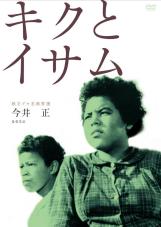
Imai Tadashi’s 1959 film about two half-black siblings in a farming community at the foot of Mt. Bandai in Fukushima Prefecture. The film interestingly came out the same year as the highly successful remake of Imitation of Life and Cassavetes’ experimental Shadows, which both deal similarly with mixed-race or light-skinned blacks, as did that year’s Bunraku puppet drama 白いお地蔵さん (The White Buddha). Wonder if it was something in the air.
The children’s mother obviously enjoyed the company of soldiers during the Occupation, but she has died, and they have never met their father (or fathers), now presumably back in the US. The sister Kiku and her little brother Isamu lead a fairly normal if poor life but are aware that they are not quite the same as other kids. While they are more or less accepted in their village, they attract stares and comments when they go into town, and even normal playground scrapes with their friends inevitably end up with taunts like “gorilla” and “blackie” (クロンボ), though the kids just shrug it off and throw it right back at them. (Isamu himself calls his sister a gorilla, probably thinking it a general insult like “fatty” or such. Kiku creatively invents her own swear word for the other kids, “yellowface” (キイロンボ), which obviously doesn’t exist in Japanese.) They have been raised lovingly by their bent old grandmother, who has always told them they are simply tan and will grow out of it. (The girl recalls that Granny told her that eating lots of rice would whiten her skin, complaining, “All I got was fat!”) The boy is perhaps too young to fully understand, and the girl’s troubles, we come to learn, lie elsewhere.
Kiku, though only 11, is much larger even than boys her age, making her stand out all the more. The film does a fine job of showing her growing awareness of her physical difference from others despite her unshakeable identity as Japanese. At one point, she is teased by some boys when she is baby-sitting and furiously runs after them, placing the infant absentmindedly in the back of a truck. When the infant is briefly driven away, observers comment on how Kiku’s foreign side has made her irresponsible. Kiku is mentally tough, responding largely with anger rather than self-doubt, but small cuts like that must take a toll. I loved the dodgeball game where she has no qualms about taking out her frustrations on the bullying kids on the opposing side. She shows a flair for acting and enjoys performing Kabuki bits before the villagers. At one point, she tries on Kabuki makeup left behind by a traveling troupe and, in a stunning image, stares in the mirror at her white painted face.
Granny, now approaching 70, has to consider the children’s future. She decides to send the boy off for adoption by a black family in the US, where he can be with others that look like him, notwithstanding the worries of one neighbor about stories of prejudice in America itself. (One says the kids should follow their seeds back to their origin, prompting the neighbor to respond, “We’re not talking about pumpkins!”) In a heartbreaking moment, the boy, upset at being taken from his sister and not clearly comprehending why, looks back tearfully as he departs.
Turning to the granddaughter, Granny sees no prospects for marriage and considers farm life no real life for a woman. She tries to encourage her to join a Buddhist convent, but Kiku resists. At the end, Granny is shocked to find that Kiku has unsuccessfully tried to hang herself, which we assume is the reaction to the accumulated societal pressure and forced separation from her brother. But there is an unexpected twist: seeing blood on her granddaughter’s leg, Granny instantly realizes the actual cause – the frightened Kiku has had her first period. The physical change on the inside has apparently pushed her over the edge. Once the situation is explained to her, however, Kiku is comforted and convinces Granny to let her stay in the village and learn how to farm. She amusingly sneers at her former tormentors in a show of self-confidence as she marches off to the fields.
The acting was impressive all around, with particularly memorable performances by Kitabayashi Tanie as Granny (earning her a Best Actress award) and Takahashi Emiko as Kiku. Mizuki Yoko’s script, also an award winner, was consistently interesting and felt real. (I guess there was no avoiding the impenetrable local accents – thank goodness for the subtitles.) Her switch in focus at the end from race to a coming-of-age story was as adept as it was unexpected; despite the title, this was really Kiku’s film. Mixed-race occupation-era kids would still have been children at that point, so the movie was ahead of its time in anticipating their adolescent troubles. An interesting and enlightening flick.
 sekenbanashi
Pingback: Until We Meet Again (また逢う日まで) | sekenbanashi