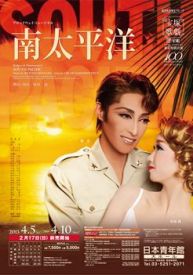
- 宝塚: 南太平洋 (Takarazuka: South Pacific)
4/10/13 (Wed), Tokyo
At first glance, South Pacific seemed the least likely of the big Rodgers and Hammerstein musicals to be given the Takarazuka treatment given the high macho factor: “There’s Nothing Like a Dame” has a whole chorus of men grumbling about the lack of women, “Younger Than Springtime” calls in the script for a shirtless guy (implying some off-stage fun), and “Honey Bun” features a man in drag with coconuts for boobs. Also, the theme of racial discrimination wouldn’t resonate whatsoever with this group’s core audience. More than that, the text states explicitly that the soldiers are there to fight the Japanese, which no one in this country wants to hear about. (In the last version I saw in Tokyo, an import from London, the subtitles used katakana, the alphabet used for foreign words, for all references to the Japanese military (ニホン軍) as if Japan were a foreign country.) But, of course, it’s a big romantic story with two juicy male leading roles, an ideal combination for these guys (girls), and the super-maleness was certainly a prime attraction for me. There was no way I was going to miss this opportunity to catch some high camp.
The set was surprisingly minimal, with just a few platforms, basic rooms and stairs shifted in and out by the soldiers when needed. There were no big drops or special effects. (This was not the main Ginza theater but a special five-day showing in an all-purpose hall elsewhere in town.) The curtains opened to a nice but simple silhouette of island girls scattered across the stairs, and the staging remained admirably restrained throughout. The direction was efficient and not overly fussy, making for an unusually naturalistic production for this group. (That said, they could have done a better job with the scene transitions, something this show pioneered on Broadway.) Moreover, the show doesn’t allow for glamorous costumes other than the formal wear at Emile’s party. The most striking outfits were the suits/uniforms for Emile and Cable.
The audience wasn’t there for the story but for the main “male” star, in this case Todoroki Yu (轟悠) as Emile. Accordingly, the show was significantly truncated and altered – the R&H people are evidently generous with Takarazuka (who have also done Carousel and a hilarious Oklahoma!). For instance, Nellie and Emile didn’t sing their “Twin Soliloquies” but joined together instead for a newly added chorus of “Some Enchanted Evening” once Emile finished the first round. Much of Bloody Mary’s part was also shortened, though she sang at least part of all her big numbers. The cuts made the show seem rushed and was confusing in part, but I doubt many people cared or noticed. It was all about the players, and Emile and Cable were as appealingly butch as it gets. They really were arresting, justifying the hype, and dominated their scenes. Emile didn’t adopt any accent to distinguish his French-ness, which I thought blunted the characterization, but that’s a long-standing problem I have with Japanese theater. I did like the big smooches, which were done with the man’s back to the audience to suggest the kisses without any actual lip-locking. As for the rest of the cast, the only real standout was a spry Bloody Mary, but the players overall got the job done, helped by the strong characterizations in the book. A strange bit of casting was the two grown women who played Emile’s children, which was almost grotesque; surely the company can bend its rules and find real kids. Aside from that lapse, the energy level overall was high, and the cast seemed to be having fun, which was infectious.
One pleasant surprise was that all of the principals had above-average singing voices, a big plus with this score. The chorus did a great job with their numbers, down to the low bass notes (of a sort) in “Dame”. Their choreography was fantastically camp and completely at odds with the story in many cases, such as the cutesy moves in “Dame” when the dancers had their hands on their hips and swung pendulum-like side to side. I especially loved the hip thrusts, crotch grabs and other attempts to show virility both in that number and “Bloody Mary”. Those alone made the show worth it. The choreography elsewhere was harmless but forgettable, like the dance-by-number “Wonderful Guy” sequence, Liat’s random movements in “Younger Than Springtime”, and a “Wash That Man” without any water. One number that did work well was “Honey Bun”, where they got around the coconut problem by having Nellie sing alone in her oversized sailor’s outfit and dance with several others for a lively sequence, followed only then by Luther and two others with gaudily painted faces and silly grass-skirt outfits (including coconuts) in a convincing equivalent of a “drag” show.
The lyrics ranged from the highly listenable (“Bali Hai”) to blather that must have been scratched out about an hour before the show. They’ve had about six decades to work on this, so there’s not much excuse for some of these, the lowest of the low being “Carefully Taught” and (surprisingly) “Happy Talk”. Several images irritatingly repeated themselves, such as flying through the sky (空を飛ぶ) . Also, I wonder who had the idea for “I love you, I love you, I love you, I love you, wonderful guy”. It’s a shame they couldn’t have given a bit more thought to the words, a problem that seems a common feature of Toho productions.
For all that, it’s impossible to take the production seriously, especially as it’s hardly aiming for high art. It was great fun for what it was, and I would see it again in a second. The Broadway musicals I’ve seen at Takarazuka (Guys & Dolls, Me & My Girl) have been uniformly excellent in their own wacky way, and this lived up to that standard. Definitely worth the price of the ticket.
 sekenbanashi
Pingback: Takarazuka: Chicago | sekenbanashi