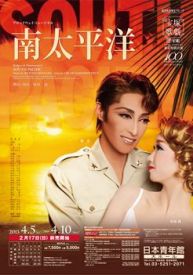
Takarazuka: South Pacific (宝塚: 南太平洋 )

Clipboard01

  • 宝塚: 南太平洋 (Takarazuka: South Pacific)

4/10/13 (Wed), Tokyo

At first glance, South Pacific seemed the least likely of the big Rodgers and Hammerstein musicals to be given the Takarazuka treatment given the high macho factor: “There’s Nothing Like a Dame” has a whole chorus of men grumbling about the lack of women, “Younger Than Springtime” calls in the script for a shirtless guy (implying some off-stage fun), and “Honey Bun” features a man in drag with coconuts for boobs. Also, the theme of racial discrimination wouldn’t resonate whatsoever with this group’s core audience. More than that, the text states explicitly that the soldiers are there to fight the Japanese, which no one in this country wants to hear about. (In the last version I saw in Tokyo, an import from London, the subtitles used katakana, the alphabet used for foreign words, for all references to the Japanese military (ニホン軍) as if Japan were a foreign country.) But, of course, it’s a big romantic story with two juicy male leading roles, an ideal combination for these guys (girls), and the super-maleness was certainly a prime attraction for me. There was no way I was going to miss this opportunity to catch some high camp.

Continue reading

Twenty-Four Eyes (二十四の瞳 )

  • 二十四の瞳 (Twenty-Four Eyes), 1/16/11 (Sun), Tokyo

With the death of the great Takamine Hideko at year-end, I gathered friends to watch one of her most successful films. It is an unabashedly sentimental piece from 1953 about a new teacher and her 12 charges in a poor village in Shodoshima over a 20-year span from 1928-1948, i.e., before, during and after the war.

Continue reading

The Exterminating Angel (Met Live)

  • The Exterminating Angel (Met Live)

1/29/18 (Mon), Tokyo

British composer Thomas Adès’ new opera, based on the 1962 Buñuel film, was a big popular and critical success in Salzburg, London and New York, and I was eager to catch this Met Live production from last November. The source film, which I had somehow never seen, happened to be playing in Tokyo at a retrospective of Buñuel’s Mexican works, so I caught that the night before.

The story, a Beckett-like setup where fancy guests at a dinner party find themselves mysteriously unable to leave the room, didn’t seem a promising subject for a full opera. For one thing, it’s largely an ensemble piece with no real leads, less about individual characters than the breakdown of the social order and how people behave in extreme situations. The film wraps up in a brisk 90 minutes or so, suggesting that a one-act opera might be more appropriate. (That appears to be the approach that Stephen Sondheim and David Ives are taking in their musical version, which will combine this film with that other Buñuel dinner-party piece The Discreet Charm of the Bourgeoisie.) The fact that this all takes place largely within the confines of a single room with the same costuming throughout also doesn’t suggest much in the way of scale or glamour. In any event, I was curious to see what Adès and his co-librettist Tom Cairns would make of this.

Continue reading

Conflagration (炎上)

  • 炎上 (Conflagration), 1/23/11 (Sun), Tokyo

Ichikawa Kon’s 1958 film version of Mishima’s then-recent novel Kinkakuji (The Golden Pavilion), a fictionalization of the notorious incident just a few years earlier when a crazed monk burned down the centuries-old structure. The novel is filled with ruminations about the nature of beauty versus reality by a narrator isolated from society by his own insecurities over his crippling stutter. His image of Kinkakuji (called here by a different name), described by his father as almost other-worldly, sets him up for a devastating letdown when he encounters the actual dilapidated structure. The temple in his mind represents an ideal that, when violated, prompts him to destroy the former to protect the latter.

The film can’t begin to compete at that level, but it is a dutiful recounting of the main events and is highly effective on its own terms. Continue reading